
A Universal Symphony or a Western Solo?
By Zoe Raptis
In the modern age, the primary argument against human rights is that they are a form of Western cultural imperialism. To evaluate this argument requires a discussion regarding whether human rights are truly universal. The essence of human rights is that they are an entitlement to every human being, but the universality of such an entrenched idea does not translate to the conception of human rights themselves as universal. This is the crux of the argument that human rights are instrumental to the West. On the other hand, the absence of an infallible universality among conceptions of human rights does not mean one conception amounts to Western cultural imperialism. Rather, humanist customary considerations transcend ideology.
Appeals to universalism have been challenged on the grounds that they overlook the absence of a homogenous moral community. States vary in their perceptions of justice and rights are largely defined by the value systems adopted by states. For instance, East Asian cultural values are not compatible with the individualist stance of the Universal Declaration of Human Rights (UDHR). That conception of human rights is based on a liberal idea that inalienable and indivisible rights are innate to all human beings; this clashes with other conceptions in communitarian cultures, where individual rights are viewed primarily as duties that a person has to the group. In South African cultures, it is the community that nurtures the individual, espousing the idea “I am because we are, and because we are therefore I am (Tharoor, 1 )” The 1993 Bangkok Declaration of Asian governments is a declaration by a majority of Asian governments on human rights. It had affirmed Asian governments support for human rights, but it had rejected the West’s focus on individual rights and the universality of human rights. Many states, such as China, justify the death penalty on the grounds of communitarian principles. Islamic cultures determine human rights within the “higher law” of Islam. The penalties available under Sharia criminal law—as in Iran and Saudi Arabia, where torture is legal—clearly contravene Article 5 of the UDHR. In 72 countries, largely in Africa and Asia, homosexuality is illegal. How can human rights be universal if the world does not share in one moral framework?
Cultural relativism holds that there is no universal moral standard for all people, as morals should be viewed as correct relative to one’s society; thereby rejecting the universality of human rights. Edward W. Said asserts in Orientalism that what is right for one society may not be right for other societies and that the West for too long has imposed its ideals on the East (Said, 1). Said articulates that the West has positioned itself as the superior culture at the expense of the East. Similarly, the criticism that human rights can be a form of Western cultural imperialism argues that Western countries, which champion human rights, may impose their own cultural values and norms on other societies, often without considering the cultural, historical, and social contexts of those societies. Thus, Said’s standpoint reflects cultural relativism, the view that each culture determines the rights that its people enjoy. The argument follows that human rights cannot claim universal validity if they are an expression of Western values, inspired by the Enlightenment, and a universal standard for human rights therefore embodies Western cultural imperialism.
On the contrary, the universalist rhetoric of human rights eclipses its historical and geographic specificity to the West. This contests the notion that human rights are a form of Western cultural imperialism. Shashi Tharoor—a proponent of unilateral universalism—states that human rights stem from a shared faith in humanity and, because of this, cultural considerations become irrelevant (Tharoor, 6). Human rights should be interpreted in the historical context of their articulation, which was a political response to World War II and the atrocities committed during the Holocaust. Louis Henkin stated that the UDHR “articulates no particular moral principles or any single, comprehensive theory of the relation of the individual to society (Henkin, 6).” The outlined rights are a product of negotiations and political consensus, which historically were supported by 58 countries. These states assembled in 1948 to affirm their “faith in the dignity and worth of all persons” in the UDHR and this included African, Asian, and Latin American nations (Richter, Shaheed). Thirty-seven states were associated with Judeo-Christian traditions, eleven Islamic, six Marxist; and four identified as being associated with Buddhist-Confucian traditions (Richter, Shaheed). It was an Egyptian delegate, Omar Lutfi, who proposed that the UDHR reference the “universality” of human rights (Richter, Shaheed). This reaffirms Tharoor’s point that human rights are indeed universal and can be accepted and upheld among diverse cultures.
After the introduction of the UDHR, numerous Western and non-Western states alike have continuously promoted human rights. When the two Covenants on Civil and Political Rights, and on Economic, Social and Cultural Rights were forwarded to the UN General Assembly for final approval, both covenants were approved by unanimous votes (the General Assembly consisted of 100 members at the time) (Richter, Shaheed). Thus, there is an international acceptance that global standards are necessary for domestic political institutions, and the participation of non-Western states in advancing recognition of human rights norms reflects the universality and widespread legitimacy of human rights.
Most importantly, even if the mainstream conception of human rights were not truly universal, that would not equate it with Western cultural imperialism. As the above evidence shows, it is false that the West alone decided on the principles contained within the UDHR. Cultural absolutists depend upon claims echoing a “clash of civilizations (Huntington, 25).” A binary outlook in international relations concerning the West and the rest is an oversimplified and essentializing perspective. Amartya Sen argues that the simplistic viewpoint regarding “Western civilization,” “Asian values,” “African cultures” and so on actually exaggerates the divisiveness of the world (Sen). To consider human rights as cultural imperialism implies a present cultural chasm, which is simply untrue. Just because human rights conceptions were partly inspired by Western Enlightenment ideals does not mean that these values are incompatible with non-Western cultures. Chinese foreign policy officials underscore American human rights violations, such as Guantanamo Bay and American war crimes committed in Iraq and Afghanistan. Granted, China does this in response to US criticism regarding their human rights violations, but it nonetheless demonstrates that Western states do not have a monopoly on appeals to human rights. China’s condemnation of the US sets an important precedent that, insofar as they participate in international institutions, non-Western nations can leverage human rights and respond to blatant patterns of abuse.
Additionally, there are some parallels between Western ideals and those of non-Western cultures. For example, the Qur’an upholds the sanctity of human life just as the UDHR does “the right to life” (UNGA, 1948). Other parallels to liberal thinking include the right to privacy and a high regard for tolerance and fairness. There is an apparent consensus between Islamic and Western cultures regarding human rights. Human rights are not necessarily universal, as justice produces different meanings for different states, but there is a universal recognition of the need to achieve justice worldwide. Hence, one can perhaps contest the universality of human rights, but one cannot argue that they are incompatible with the ideological diversity among local cultures. As such, Article 27 of the ICCPR states that “in those States with ethnic, religious or linguistic minorities, persons belonging to such minorities shall not be denied the right to enjoy their own culture, to profess and practice their own religion, or to use their native language” (UNGA, 1966). It can thereby be seen that the importance of cultural rights is reinforced and human rights is acting contrary to Western imperialism by bolstering any minority’s rights regardless of if their views align with the West.
Human rights are influential due not to Western cultural imperialism, but to the fact that we live in a globalized world which recognizes multicultural perspectives. By no means can the limited claim human rights conceptions make to universality be equated with imperialism. Between diverse cultural backgrounds there is a worldwide consensus regarding a justice to be strived for.
Zoe Raptis is a sophomore at Tufts University studying Political Science and Philosophy.
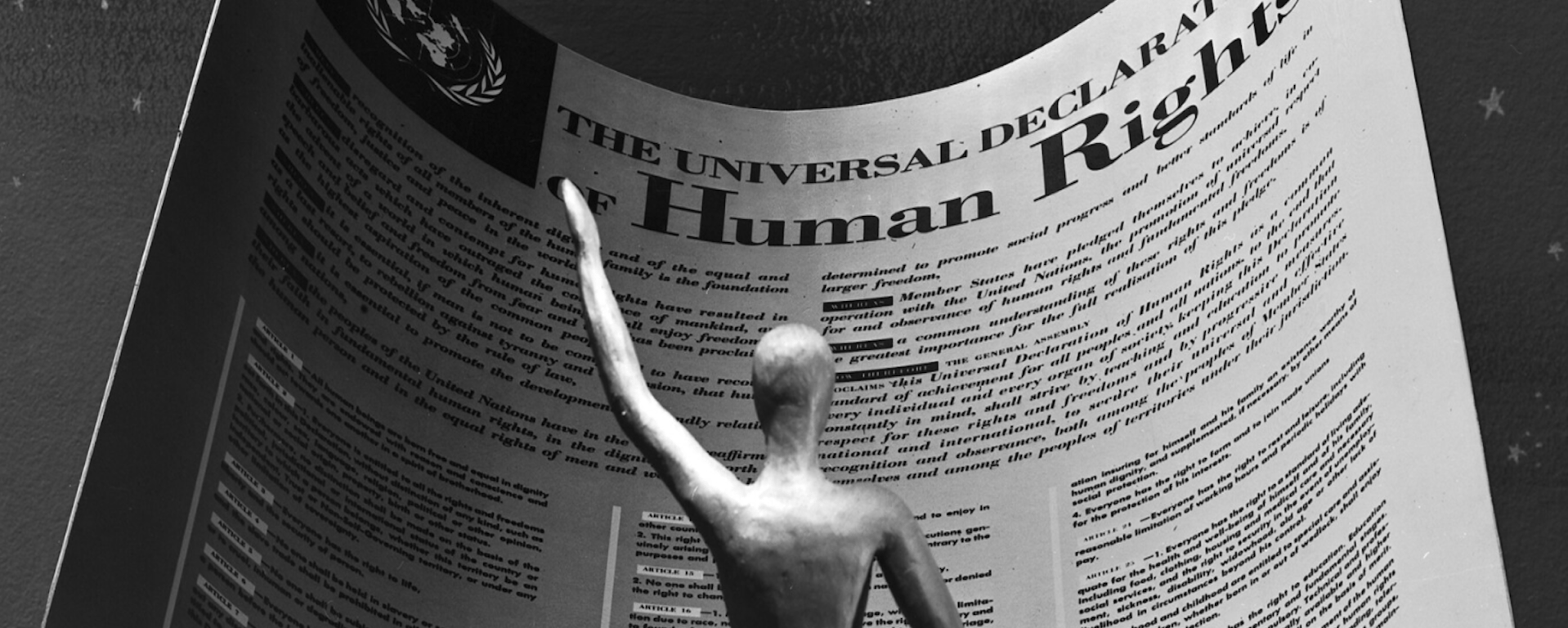
Image: Still frame from the film Universal Declaration of Human Rights
Image Courtesy: United Nations Photos on Flickr
Works Cited
Henkin, Louis. The Age of Rights. Columbia University Press, 1990.
Huntington, Samuel P. “The Clash of Civilizations?” Foreign Affairs 72, no. 3 (1993): 22–49. https://doi.org/10.2307/20045621.
Said, Edward W. Orientalism. Pantheon Books, 1979.
Sen, Amartya. Human Rights and Asian Values. Morgenthau Memorial Lectures on Ethics & Foreign Policy 16. Carnegie Council on Ethics and International Affairs, 1997. https://www.carnegiecouncil.org/media/series/morgenthau/morgenthau-lectures-1981-2006-human-rights-and-asian-values.
Shaheed, Ahmed, and Rose Parris Richter. “Is ‘Human Rights’ a Western Concept?” IPI Global Observatory, 17 Oct. 2018. https://theglobalobservatory.org/2018/10/are-human-rights-a-western-concept/.
Tharoor, Shashi. “Are Human Rights Universal?” World Policy Journal 16, no. 4 (1999): 1–6. http://www.jstor.org/stable/40209657.
United Nations General Assembly. International Covenant on Civil and Political Rights, Resolution 2200A (XXI) § (1966). https://www.ohchr.org/en/instruments-mechanisms/instruments/international-covenant-civil-and-political-rights.United Nations General Assembly. Universal Declaration of Human Rights, 217 A (III) § (1948). https://www.refworld.org/docid/3ae6b3712c.html.
 Hemispheres