
by Max Druckman
The North Atlantic Treaty Organization (NATO) was formed in 1949 between twelve nations: ten in Western Europe in addition to the U.S. and Canada. The organization was to serve as a peacetime military alliance and counterweight to the Soviet Union’s Eastern Bloc. Following the mass devastation of World War II, the U.S. sought to prevent Soviet interference in the rebuilding of Europe. For the U.S., an economically developed and armed Europe would provide the best course of action to that end. Thus, the signatories of the North Atlantic Treaty declared an “attack against one an attack against all” in 1949. This agreement is known as the mutual assistance clause.
In the decades since its formation, NATO has expanded significantly. In 2020, upon North Macedonia’s admission, there were thirty total members. Three nations —Bosnia and Herzegovina, Georgia, and Ukraine — are designated “aspiring members”. In order for a nation to be granted admission to NATO, all existing members must vote unanimously in favor. That being said, admissions procedures remain open to any nation in Europe. After agreeing that a nation may join the alliance, each member must ratify the Accession Protocols to complete the process.
The question of new member ascension has become one of widespread debate since the Russian invasion of Ukraine on February 24, 2022. Russian President Vladimir Putin cited Ukraine’s potential ascension to NATO as one of the grounds for that invasion. Moscow designated the alliance’s prior expansions as instances of Western aggression towards Russia. In a 2008 summit in Bucharest, NATO members had agreed that Ukraine would join the alliance at some future, unspecified date. However, Ukraine was never extended a Membership Action Plan. For that reason, Ukrainian President Volodymyr Zelenskiy repeatedly pressed the organization to extend the plan and route to membership. NATO has hesitated prior to and throughout the present conflict for a number of different reasons. The main one is NATO’s mutual assistance clause. Were Ukraine to join, the alliance would immediately become an active belligerent in the Russia-Ukraine conflict. Thus, while Secretary-General Jens Stoltenberg reiterates the 2008 conclusion, he holds that Ukraine will not join NATO while it is at war.
Two more dilemmas facing the alliance are Sweden and Finland. Both nations were invited to join NATO directly at the 2022 summit in Madrid in an effort to counteract Russian expansion in Eastern Europe and build greater alliances that border Russia in order to limit its influence. Finland strayed from decades of military neutrality and became NATO’s 31st member in April 2023. Only Finland’s process for ascension was swift and relatively uncontroversial. By contrast, Sweden’s ascension has met resistance from President Tayyip Erdogan of Turkey. In July 2023, Erdogan stated that Turkey would not support Sweden’s candidacy on the grounds that Sweden harbored individuals it deemed as terrorists. Ankara wants Sweden to take action against the Kurdistan Workers’ Party (PKK), an outlawed separatist group it deems responsible for the 2016 coup attempt in Turkey. Sweden too has labeled the PKK a terrorist group, but ongoing pro-PKK protests in Sweden convinced Erdogan that the nation remains a safe haven for it. President Victor Orbán of Hungary, another NATO member, has insisted that other members listen to Turkish concerns.
October 2023, Ankara reiterated that it would continue to delay ratification of Sweden’s membership while it awaited American approval for Turkey’s purchase of F-16 fighter jets. Its military is NATO’s second-largest, so the demand to bolster its defense interests in the name of growing the organization is fairly valid. Erdogan said that he would send the issue to the Turkish parliament when it opened at the beginning of October. Just prior to parliament’s resumption, however, the KK bombed government buildings in Ankara to the effect of delaying that course of action.
Since then, Erdogan has submitted a bill to the Turkish parliament that would ratify Sweden’s membership. That being said, he still believes that Stockholm has not sufficiently condemned or acted against the PKK. Erdogan has recently stated that planning his government’s 2024 budget is parliament’s current priority, meaning Sweden’s membership will face further delay. With the war in Ukraine continuing to rage on, Sweden’s ascension into NATO is a critical component of the organization’s effort to diminish Russian influence. However, the continued stalling of its membership can limit NATO’s ability to be united during a time of conflict.
Max Druckman is a freshman at Tufts University.
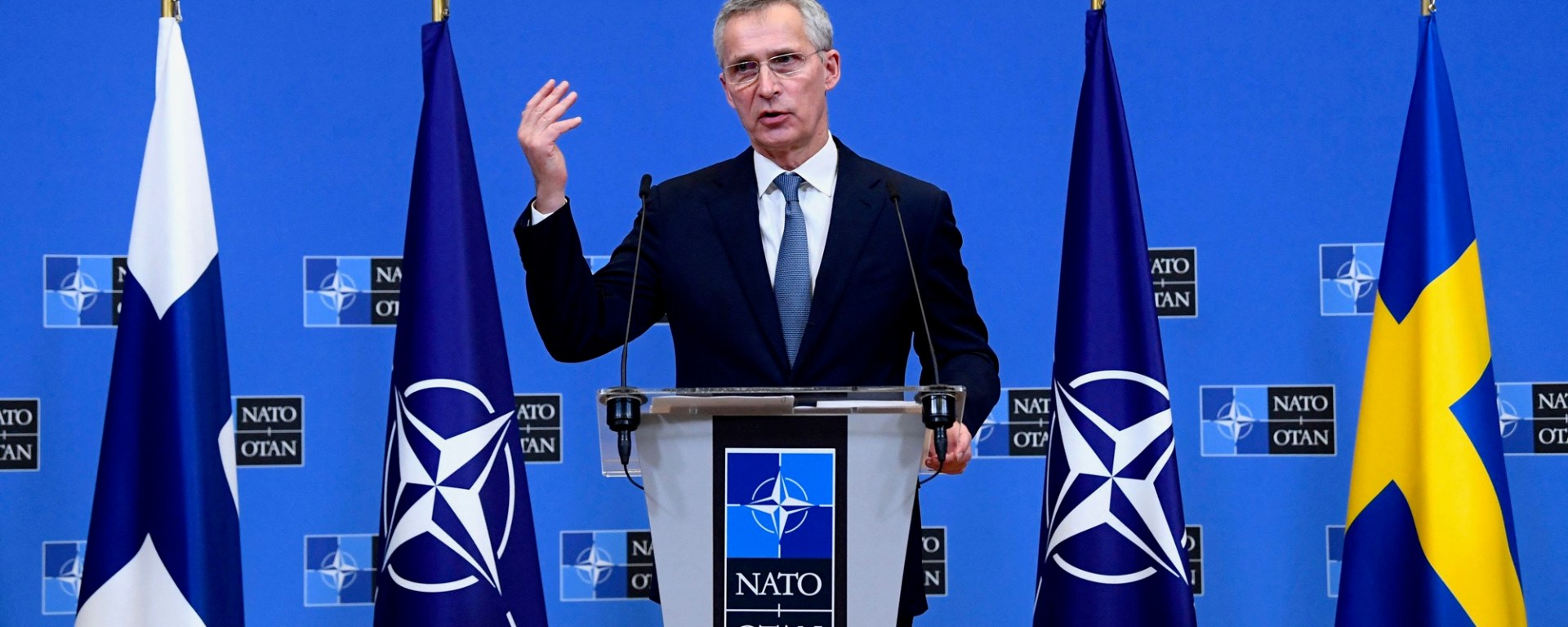
Image: Secretary General Jens Stoltenberg of NATO
Image courtesy: John Thys/AFP/Getty Images on Bloomberg
This piece is a reproduction from its original issue in Hemispheres vol. 47, no. 1.
 Hemispheres
One thought on “NATO Expansion and the War in Ukraine”
Comments are closed.