
Recent Political and Economic Tensions Between Ethiopia and Eritrea
By Zachary Myers
The Horn of Africa is a region marked by historical complexities and geopolitical intricacies. Recent political and economic tensions between Ethiopia and Eritrea have once again brought this volatile region into the global spotlight. This article will delve into the dispute’s historical origins, which date back to the colonial era, and will explore both nations’ current perspectives on the issue. Furthermore, an analysis of the Algiers Agreement, an open border policy, and Ethiopia’s new agreement with Somaliland create a robust picture of why this conflict has re-emerged in the current global political climate.
The roots of the Ethiopia-Eritrea conflict can be traced back to Italy’s occupation of both countries in the late 19th and early 20th centuries. This shared colonial influence, in concert with the federation of Eritrea with Ethiopia by the United Nations in 1952, allowed Ethiopia to maintain sovereignty over Eritrea after World War II. Eritrea had long resented this lack of sovereignty, and tensions escalated after a coalition of armed groups, notably the EPLF and the TPLF, defeated the communist Ethiopian government and declared independence for Eritrea in 1991. Eritrea subsequently reclaimed its original borders, a point of contention due to their formally undeclared status.
Consequently, war broke out in 1998 when a border dispute flared into armed conflict. Over 70,000 were killed during this conflict as a result of failed embargos from the United Nations, lack of enforcement behind the U.S./Rwanda peace plan, and weak mediation efforts by the Organization of African Unity (OAU). These failed peace attempts were ineffective and only elongated the conflict by muddling attempts at real peace talks between the fighting states. Due to their relatively amicable status in the region, the United States and Rwanda worked together to facilitate and promote a peaceful and durable settlement of this dispute and to prevent a war. Despite strong urges by the U.S. and Rwanda, Eritrea refused to settle for peace, and the conflict ensued. Another hope to prevent full-scale war in the region was the OAU. It worked to maintain the agreement between most African states that required them to recognize the borders as they had been defined by the UN after World War II. In theory, this agreement represented the liberation of Africa and its freedom from foreign influence. Yet, in practice, the OAU failed to preserve this agreement. As stated by Adriano Nuvunga, a human rights lawyer for the Center for Democracy and Human Rights, the OAU “[was] toothless and ineffective, and it repeatedly proves itself incapable of ensuring prosperity, security, and peace for all Africans.” It is no surprise that the OAU has since been replaced by a distinct organization called African Unity. Since the OAU’s power was not respected in the region, Eritrea refused to accept the OAU’s terms for peace until Eritrea realized that its loss was imminent.
The conflict officially ended in defeat for Eritrea in 2000 with the signing of the Algiers Agreement, which established the Eritrea-Ethiopia Boundary Commission (EEBC) to demarcate the border. However, this agreement proved much harder to enforce than expected. From 2000 to 2005, despite relative stability between the two countries, behind-the-scenes actions placed the region in a tense situation. Eritrea backed the Oromo Liberation Front, a rebel group seeking the independence of a region in Ethiopia called Oromia, allowing many of its leading officials to work within Eritrea. Ethiopia retaliated by announcing its support of the Islamic regime in Sudan, which had been accused of inciting the Eritrean Islamic Salvation conflict. During this dispute, the Eritrean Islamic Jihad Movement and the Eritrean Liberation Front sought to forcibly overthrow the government in an effort to create an Islamic-run state. With both of these groups based in Sudan, Ethiopia’s alignment with the Islamic regime of Sudan was clearly a step towards escalation. Though after the enactment of the Algiers Agreement in the early 2000s, this escalation highlights the challenges that the agreement originally faced which led to a prolonged stalemate and regional destabilization.
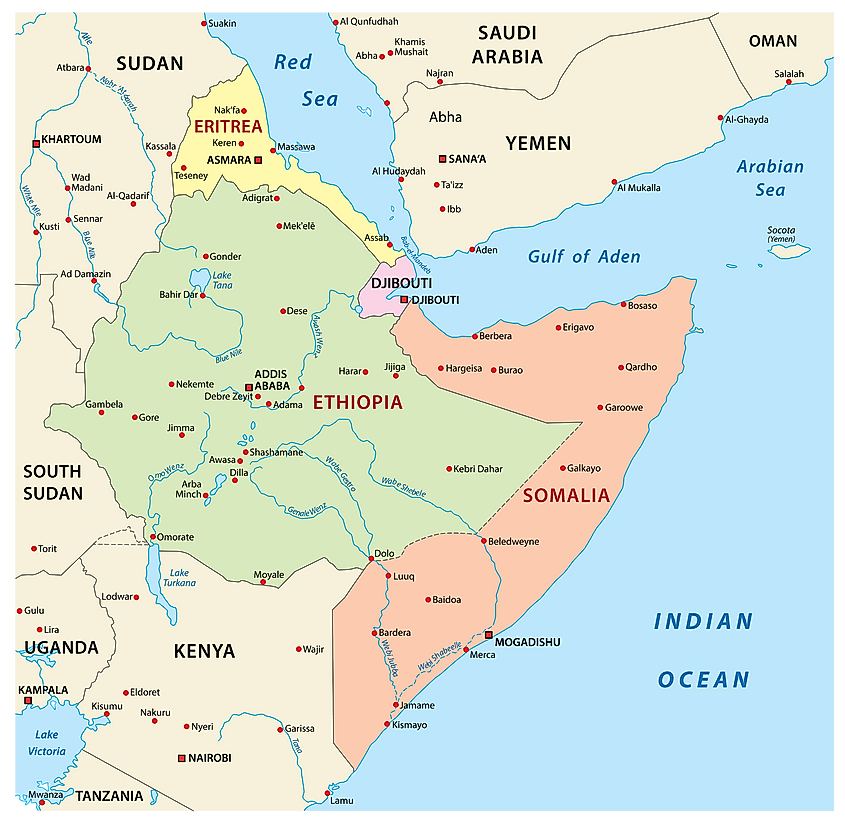
In recent years, Ethiopia and Eritrea have been oscillating between a hostile and cooperative relationship. Despite continued support of the Algiers Agreement from the UN and major global powers like the United States, both nations continue to accuse each other of violating the agreement. More fighting looked unavoidable as both states have continued to rearm since 2015 and Eritrea cut Ethiopia’s access to the Red Sea. However, in 2018, both countries agreed to take massive steps towards prolonged peace by restoring diplomatic relations, reopening direct flights to and from both countries and opening their borders to facilitate trade. However, this hope of peace was shortlived when the borders reclosed in 2018 when Eritrea cut Ethiopia’s access to the Assab Port. Since Ethiopia believes it is entitled to Red Sea access, Eritrea is now bracing for a large-scale invasion by Ethiopia, evidenced by heightened airplane activity and troop movements near the border. Despite attempts by Nobel Peace Prize winner and Ethiopian Prime Minister Abiy Ahmed to reach peace, it appears as though he is contemplating war to achieve what he believes is Ethiopia’s destiny: glory and economic improvement. Citing that Ethiopia is the world’s most populous landlocked country, Ahmed is quoted saying that access to the sea is an existential question. Although Ahmed has been vocal that “Ethiopia has never invaded any country and will not do so in the future,” Ethiopia’s aggressive posture and increased presence on Eritrea’s border suggest otherwise.
If war is to break out, Eritrea’s Assab region, which is active in trade, is at high risk as it is near the shared border and susceptible to drone strikes and a military invasion. If required to reinforce that region, Eritrea will have to relocate some of its 40,000 troops currently on its borders with Tigray, risking a re-eruption of conflict with Tigray on those borders. This re-emergence of tensions coincides with shifts in the global political climate. The geopolitical dynamics of the Horn of Africa have been influenced by changing alliances and power struggles. Ethiopia’s strategic importance in the region has drawn attention from global powers, impacting the dynamics between Ethiopia and Eritrea. As Ethiopia garners support from significant actors like China, Eritrea is sure to feel weak and threatened, possibly encouraging it to seek other military allies.
In another part of the Horn of Africa, Ethiopia’s recent deal with Somaliland includes a strategic partnership and access to the port of Berbera, giving Ethiopia access to trade and the Red Sea once again. By obtaining this access, Ethiopia is moving away from dependence on trade with Eritrea. While access may enhance Ethiopia’s economic opportunities, it also alters the balance of power between itself and Eritrea. By strengthening its security and inserting itself as a major power in the Red Sea, Ethiopia now appears a more formidable enemy for Eritrea. By supporting internationally unrecognized Somaliland, Ethiopia is generating regional support from other countries that want formal recognition of Somaliland.
In conclusion, the recent political and economic tensions between Ethiopia and Eritrea are rooted in a complex history, aggravated by shifting economic incentives. The outcomes desired by both nations, coupled with Ethiopia’s evolving regional engagements, contribute to the delicate balance in the Horn of Africa. As the international community observes these developments, the need for diplomatic solutions and regional cooperation to ensure stability, peace, and access to the vital trading route of the Red Sea becomes increasingly apparent. Control over the Red Sea has become an increasingly violent contest in recent months after Yemen’s radical Houthi group attacked trading ships passing through the internationally recognized trading route. This author fears that this increase in tension in the region may spark violence across other small states that want a piece of the Red Sea. It is often more expensive for weaker states to maintain peace; for two of the weakest states in the world that need to focus investments on human rights, education, and health care, this is a worrisome note. Especially as Ethiopia seems poised to attack with much stronger regional and international backing, Eritrea will need a massive ramp-up in strength to reach a level where peace can be ensured. The only way this author sees this as a possibility is if Eritrea receives large chunks of developmental aid from organizations like the African Unity and the UN that request peace in the region. If not, this author does not see a way that conflict can be avoided.
Zachary Myers is a freshman at Tufts University studying International Relations and Economics.
Image: The Horn of Africa (Sundus Ahmed / Blackpast.org)
 Hemispheres