
A Roundtable Discussion
By Grayton Goldsmith, Stewart James, Rohith Raman and Jason Wu
The rise of BRICS and BRICS+
By Stewart James
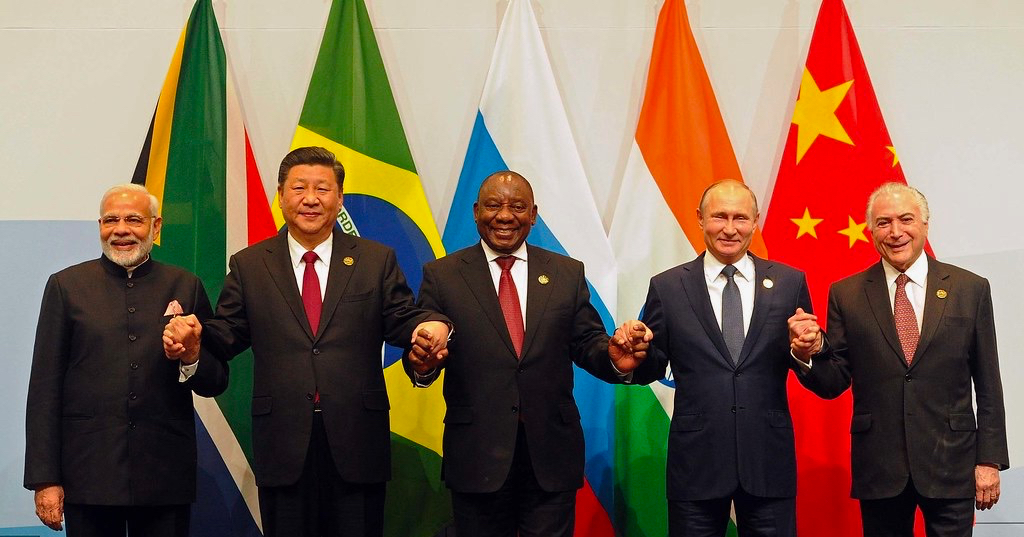
BRICS (now BRICS+) is an intergovernmental economic forum between Brazil, Russia, India, China, and South Africa. It poses an alternative to the G7—a powerful council of industrialized countries between North America, Western Europe, and Japan. These five members represent 3.23 billion people, almost tenfold the US population and roughly 40% of Earth’s inhabitants. BRICS also contributes a quarter of global GDP, a larger share than the G7’s. Though established over a decade ago, the bloc has attracted considerable recent attention. At their annual summit in Johannesburg this past year, BRICS decided to incorporate six new members among dozens of applicants: Argentina, Egypt, Ethiopia, Iran, Saudi Arabia, and UAE. Together their share of global GDP would jump by four percentage points and that of the population by six. Argentina has since deferred its entry. Javier Milei, inaugurated in December, vows not to “do business with any communist,” shaking his fists at the CCP and Lula da Silva of Brazil. Still, BRICS+ is a big deal.
In 2001, a Goldman Sachs analyst first drew attention to the four economies of Brazil, Russia, India, and China. He predicted that the BRICs, for short, would assume the greatest share of world economic growth between then and 2050.24 Indeed, if one includes South Africa, the BRICS countries are developing much more rapidly than those of the G7. While G7 countries have experienced annual GDP growth of 2% on average, BRICS has witnessed rates of over 8%.
Throughout the 2000s, the five governments also aligned their concerns toward the existing economic order. The IBSA (India, Brazil, and South Africa) Dialogue criticized the IMF and World Bank of disproportionate influence by the Global North. They advocated “South-South Cooperation” on trade, fiscal, and financial policies, much as the Third World Project and Non-Aligned Movement did in the twentieth century. Ministers from Brazil, Russia, India, and China convened in 2006 before grouping formally amid the global financial crisis. South Africa joined in 2010.
The immediate collective cause of BRICS was to reform economic governance where the World Bank and IMF had failed. It was conceived secondarily as a force for multipolarity and counterweight to the G7. By its 2010 expansion, the forum established an agenda based on principles of the IBSA Dialogue. Existing multilateral institutions, BRICS held, had demonstrably neglected the needs of industrializing countries. The Great Recession and its global reverberations were icing on the cake. Even Joseph Stiglitz—Chief Economist of the World Bank from 1997 to 2000—testifies,
The critics of globalization accuse Western countries of hypocrisy, and the critics are right. The Western countries have pushed poor countries to eliminate trade barriers, but kept up their own barriers, preventing developing countries from exporting their agricultural products and so depriving them of desperately needed export income. The United States was, of course, one of the prime culprits… Special commercial and financial interests prevailed.
The World Bank and IMF once embodied Keynesian principles of expansionary policy and market intervention, which aligned with postwar development goals. In the 1980s, however, a paradigm of austerity took hold amid the neoliberal revolution. The IMF began stipulating contractionary measures on the part of its debtors. Social spending was privatized and policy made technocratically. Capital markets liberalized, driving speculative hot money into Asia and Latin America; when inflows reversed, currencies and banking systems collapsed. The global recession delivered credibility to criticisms levied against this economic order, which plainly subordinated the demands of industrializing economies.
BRICS is formulating an alternative order of international economic governance. Trade and investment links among members have proliferated under Chinese and Indian capital, also due to agreements to denominate transactions in each other’s currencies in lieu of the US dollar. In fact, BRICS envisions a new global reserve currency to that end. The forum has also established a New Development Bank and Contingent Reserve Arrangement, each with an initial authorized capital of 100 billion USD, to serve the functions of the World Bank and IMF respectively. All these initiatives decrease dependence on the Global North.
BRICS receives many criticisms, not least that it reproduces the very paradigms and practices it deplores. For Vijay Prashad, the forum is a “conservative attempt” to earn its constituent governments the same asymmetric influence as the G7. Because BRICS initiatives focus on aggregate growth and capital, some hold that they might enrich members’ wealthiest strata without empowering their popular majorities. The recent admission of resource-rich countries including Iran, Saudi Arabia, and UAE does little to dispel such claims.
Another debate persists around BRICS+ regarding its implications for the US. Many voice concerns toward this forum’s alternative economic arrangement, not to mention the geopolitical stakes of its membership. Does a BRICS+ order, commentators ask, pose a threat to US hegemony? Below are two sets of arguments—for and against.

BRICS eschews U.S. influence abroad
By Rohith Raman and Jason Wu
The BRICS expansion to BRICS+ threatens US hegemony in numerous ways. It will decrease the dollar’s power, challenge US and Western energy infrastructure, and facilitate diplomatic relations that threaten Western spheres of influence.
As a global reserve currency, the dollar imparts great financial power to the US over other countries. Most international trade is conducted in dollars. As of 2022, over 60% of all central banks hold their foreign exchange reserves in dollars. This creates conditions of dependence on the American economy, which is often weaponized against others in the form of sanctions and internal instability. In 2013, Indonesia’s reliance resulted in the value of its rupiah plummeting after a market panic. For European allies, American sanctions on countries like Iran forced them to enact measures like the Instrument in Support of Trade Exchanges to continue trading.
Global financial institutions have further cemented US hegemony. In the wake of WWII, the US directed aid from the World Bank and revoked loans to Poland, France, and Czechoslovakia because of their communist presence. The IMF has a similar historical reputation of providing economic redress to countries while simultaneously “meddling in the domestic affairs of sovereign states for the sake of globalizing…under US Dominance.” In attempts to proliferate Western economic models, the IMF has pressured countries in Latin America, the Caribbean, and Africa into drastic economic transitions.
The emergence and expansion of BRICS could shift the tides from the US in favor of countries’ domestic economic prowess. To decrease dependence on the dollar, BRICS countries have prioritized the use of alternative currencies in settlements and trade agreements, including recent deals made between India and UAE. In fact, of all Russia’s exports to BRICS countries, only 36% are represented by the dollar, which is a 50% decrease since 2018. Strengthening local currencies ensures that emerging economies are less reliant on the dollar and susceptible to market fluctuations and sanctions. For this reason, many countries across Asia express interest in joining the bloc.
BRICS is also developing a new currency that could compete with the dollar as a global reserve standard. After announcing that this prospective currency will be based on the gold standard, gold purchases among central banks and BRICS countries have increased significantly while central banks have reduced their stock of dollars, showing substantial support for a new competitive currency. This may sow the seeds for future economic competition with the US.
The bloc’s expansion indicates global energy and resource infrastructure as emerging priorities. Not only did BRICS already include the world’s first and third largest importers (China and India), but its recent additions endow BRICS+ with 43% of global oil production and 29% of global GDP. New membership has hence proven a decisive tool to accommodate various oil interests without US intrusion. Moreover, Egypt is the 13th largest natural gas producer and contains the Suez Canal. Argentina is working on significant oil pipeline projects and is emerging within the market. Even Ethiopia, which works with China’s Belt and Road Initiative, could help mediate access to the Red Sea and ultimately the Suez Canal.
This is indicative of the bloc’s interest in leveraging global resources. BRICS+ will control 72% of all rare minerals and secure full discretion in shaping global resource politics. US dependence on lithium for military and aerospace developments could pose a problem now that BRICS+ includes two of the largest lithium producers globally (Brazil and China; Argentina, the one that got away, is another). As BRICS+ centralizes resources, export restrictions will force the US into compliance. They are already increasingly common among members including China, which imposed 35 in 2021.
BRICS+ will not only put pressure on American hegemony but scramble global hierarchies of power. Western states face a world order led by rivals like Russia and China while alliances grow among non-Western countries. In both branding and action, BRICS has repulsed Western encroachment. Amid the Russia-Ukraine war, for example, India refused to abide by mandated sanctions on Russia.
This question of global leadership will only grow more pressing. China, and to a lesser extent Russia, wield significant power over the bloc, despite claims toward multipolarity. China contributes to roughly 70% of the bloc’s combined GDP.28 BRICS+ could provide it a medium to extend its aggressive economic foreign policy, with the Belt and Road Initiative and Asian Infrastructure Development Bank as groundwork. Hence, China has long pushed for BRICS expansion, even while others express reservations. Critics also refer to BRICS+ as an international “repressive” alliance in that new additions are motivated by shared authoritarian practices. China and Russia have an extensive list of human rights violations, from the Uyghurs to Ukraine. Egypt, Iran, Saudi Arabia, and UAE all receive major international scrutiny for their outright authoritarian rule. This presents an especially great challenge for the US. BRICS+ is diversely composed of both American adversaries and allies; despite its condemnations of authoritarianism, the US may need to entertain BRICS lest it break alliances.
A crisis of identity in BRICS+ permits continued US dominance
By Grayton Goldsmith
“We don’t want to be told what is right for us. We want the fault lines of the current global governance architecture to be redesigned, to be reformed, to be transformed. And we want to be part of the process to create a more equitable, a more inclusive, a multipolar global community where we have fairness and justice in terms of how we conduct ourselves.”
— Anil Sooklal, South African Ambassador to BRICS
BRICS is a force to be reckoned with. Regardless of its ultimate success or failure, the alliance proves that the formation of a multipolar world order is not only possible, but inevitable. The overwhelming demand for membership in the bloc sends a clear message that the Global South is no longer content with a unipolar world—a world in which the United States can make (and break) the rules as it so pleases. The launch of initiatives like those of the New Development Bank (NDB) and the BRICS Interbank Cooperation Mechanism are rooted in a shared drive for de-dollarization and increased use of local currencies.
After seeing lackluster return on investments tied to the Belt and Road Initiative, renewed Chinese interest in BRICS and the NDB has brought them back to the forefront of current discourse. The NDB was established in 2014 with the express purpose of financing infrastructure projects in local currencies. Conforming to BRICS’ founding tenet of equality, the bank’s initial subscribed capital of US $50 billion is distributed equally amongst the five original members of the bloc. Unlike the broad-in-scope Asian Infrastructure Development Bank, the NDB is distinguished by its clear emphasis on “high-impact operations that are climate-smart, disaster-resilient, technology-integrated and socially-inclusive.” Despite its lofty goals, the bank remains acutely dependent on the US dollar. Nearly ten years on from its founding, local currency financing represents less than a quarter of the bank’s portfolio. Although the current president has hopes to increase that number to thirty percent by 2026, it is obvious that weaning off the dollar will be far more difficult than BRICS countries had initially envisioned.
This shared drive for de-dollarization and sustainable development has previously proven sufficient to sustain the alliance despite its discordant foreign policy. However, with the recent additions of Egypt, Ethiopia, Iran, Saudi Arabia, and the UAE, that could all be set to change. Following the 2023 BRICS Summit, only Argentina and the aforementioned five out of forty-plus interested countries were invited to join the bloc. The choice of admitted countries is telling of the group’s shifting priorities. Whereas prior summit declarations placed emphasis on biofuels and energy efficiency, the 2023 declaration stressed the importance of fossil fuels in supporting the energy transition. To that effect, the expansion will more than double BRICS’ share of global oil production, despite only adding a meagre three percent to its share of global GDP. Furthermore, BRICS+ will be responsible for more carbon emissions than the rest of the world combined. For an organization that continues to pride itself on its uncompromising commitment to sustainable development, a crisis of identity seems both imminent and unavoidable. Although renewed Chinese interest in the alliance will undoubtedly garner it more attention on world stage, recent moves seem to suggest that it may do more harm than good. If BRICS continues down the path set during the 2023 Summit, it leaves itself increasingly vulnerable to subsumption by Chinese interests.
This shift in focus towards resource-rich countries as evidenced by the 2023 summit carries with it an inherent move towards authoritarianism. Because countries rich in natural resources are often more prone to experience democratic backsliding, BRICS will increasingly lend itself well to characterization as an undemocratic, anti-Western organization, likely tarnishing its reputation on the world stage and harming its expansion prospects. BRICS has already begun to feel the consequences of its shifting priorities, with Argentina opting to indefinitely defer its accession to the bloc, citing fears of an authoritarian leaning. Furthermore, were the bloc to abandon its position as the forerunner in global sustainable development, it would leave that post open for the United States to take its place. As the entire world begins to feel the effects of climate change more acutely, presenting oneself as a “sustainable development power “seems to be a surefire way of ensuring continued importance, thus delaying the establishment of a multipolar world.
While emergence of an alliance helmed by two of the most prominent challengers to the established world order could be seen as the resurfacing of a powerful anti-Western force on the world stage, that’s just not what BRICS is. In fact, its political ambiguity is arguably its greatest strength. Yet with the recent expansion, the bloc finds itself at a crossroads. As it seeks to transition from nascent economic alliance to formidable global force, its next steps are crucial. Rather than boldly reaffirming its commitment to multipolarity, the 2023 Summit appeared instead to reinforce the very dynamic it sought to dispose of. If BRICS is to ever truly challenge American hegemony, it must not cave to the interests of a single member state.
Grayton Goldsmith, Stewart James, Rohith Raman, and Jason Wu are all undergraduates enrolled at Tufts University. Grayton is a freshman studying International Relations; Stewart is a senior studying History, Economics, and Middle Eastern Studies; Rohith is a junior studying International Relations; and Jason is a senior studying International Relations and Computer Science.
Image: BRICS leaders at the 10th Summit (GovernmentZA on Flickr)
This piece is a reproduction from its original issue in Hemispheres vol. 47, no. 1.
 Hemispheres