
Foreign Policy Perceptions in Washington and Beijing
By Theodorus Ng and Miles Bondi
The ever-intensifying strategic competition between the US and China has conjured fears over a potential World War III. Our article analyzes foreign policy rhetoric from Washington and Beijing toward the most visible flashpoints in East Asia—Taiwan, the South China Sea, and the Korean Peninsula. By triangulating rhetoric, actions, and intervening factors, we show where both sides stand on these issues today.
We designed a program in R for sentiment analysis of official government documents and press releases from the US Department of State (DOS) and from China’s Ministry of Foreign Affairs (MFA). Briefly, the R program matches the most frequently invoked words on either side toward each flashpoint to the sentiments with which they were invoked. We employed the NRC Word-Emotion Association Lexicon as a metric, and relevant R packages, to design our program. What is expressed by a country only tells us one side; for a comprehensive analysis, we also actively consider the actions of said country to examine matches or mismatches between rhetoric and behavior. Due to considerations of feasibility, we situate our analysis between 2020 and the present since the pandemic marked a disjunctive event that contributed to the ostensible hardening of stances toward the respective flashpoints, as well as for contemporary relevance. We analyzed a total of 200 documents containing 96,364 words, and the graphical results of our study can be found on the Hemispheres website.
Taiwan
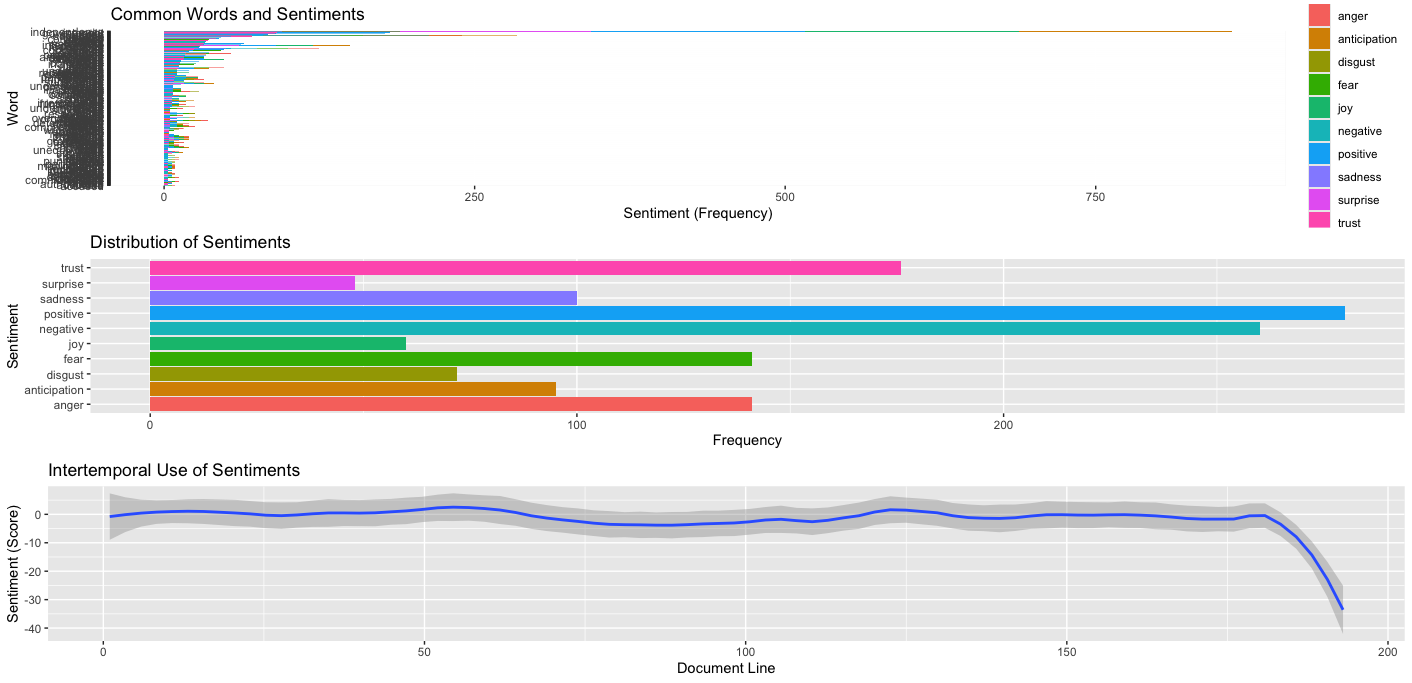
Beijing expresses much trust in its ability to preclude Taiwan’s independence, but also fear and anticipation for the wider havoc it might have to contend with in doing so. Noteworthy is the sharp dip toward more negative sentiments expressed in later documents, likely following the 2024 election of Taiwanese President Lai Ching-te—representing the third successful election for the Democratic Progressive Party, which has advocated for a separate Taiwanese national identity and continues to criticize China’s claims of sovereignty over the island. A hardening of stances on either side of the strait is also captured in Beijing’s recent policy of executing “Taiwan independence forces,” essentially Chinese political opponents, traveling to China—a move attributing a pejorative criminal status to Taiwanese people.
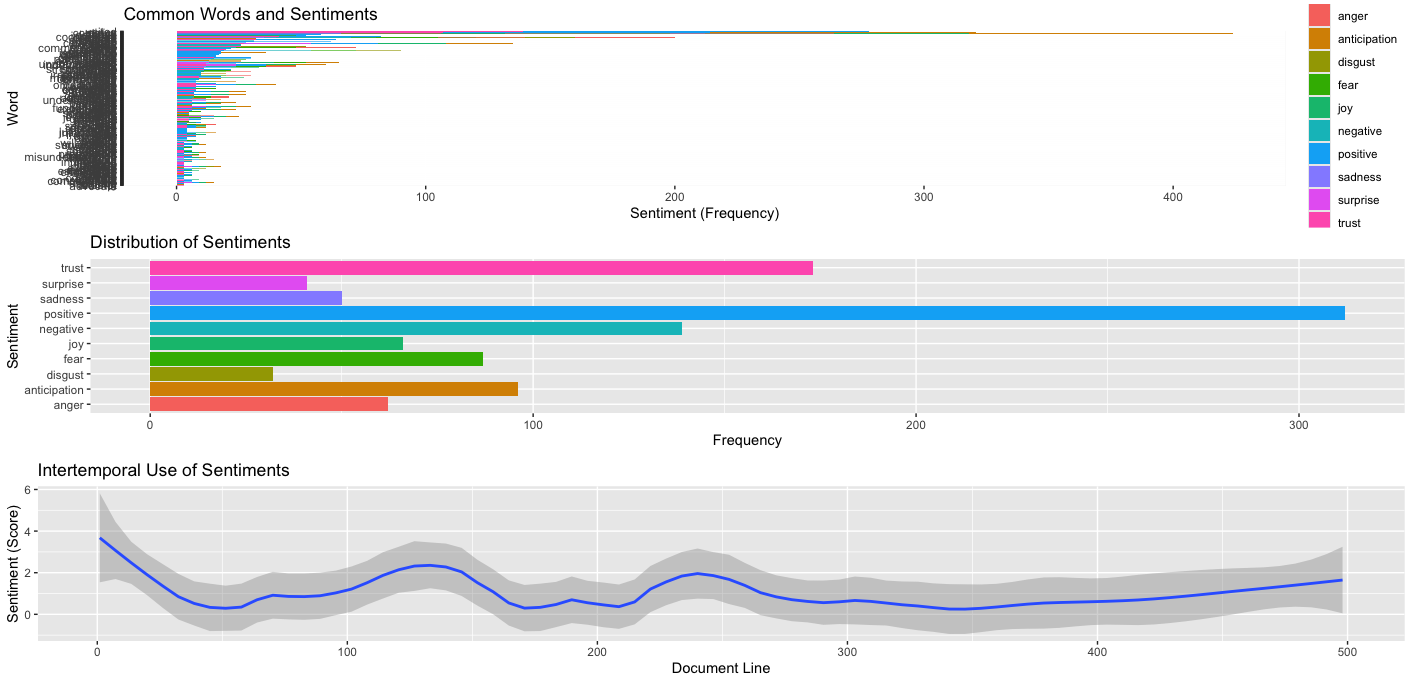
Washington views Taiwan as a bastion of democratic freedom—-an antithesis to China. Rise in US support for Taiwan and decline in U.-China relations were exacerbated by the 2016 Trump administration’s “tough on China” narrative, which garnered bipartisan support. The same narrative has held through the Biden administration and will likely continue into Trump’s second term. In recent years, much of the upheaval regarding Taiwan has surrounded Nancy Pelosi’s visit in 2022 and then Taiwanese President Tsai Ing-Wen’s visit to California in 2023. Regardless, Washington has made its position to mainland China clear: it will protect Taiwan’s right to a democracy.
South China Sea

The Chinese MFA’s most invoked ideas of “peace,” “cooperation,” and “law” regarding the South China Sea (SCS) are viewed overwhelmingly with positivity and trust. This aligns with the establishment of the ongoing Bilateral Consultation Mechanism with the Philippines, and Code of Conduct negotiations with ASEAN. Yet, Beijing’s diplomatic rhetoric rarely aligns with its actions. Should Beijing truly seek a peaceful resolution in the SCS, and cooperation based on international law, it must cease its non-peaceful gray zone aggressions. We observe dips toward more negative sentiments within the MFA toward the SCS, roughly coinciding with Manila’s hardening support in 2022 for the 2016 Hague ruling that rejected China’s “nine-dash line” claims, as well as with the Philippines welcoming expanded US military presence in 2023. MFA sentiments have become more negative recently, likely following Philippine President Bongbong Marcos’ declaration at the 2024 Shangri-La Dialogue: “If a Filipino citizen is killed by a willful act, that is, I think, very, very close to what we define as an act of war…our treaty partners, I believe, also hold that same standard.”

“Upholding international law” in the SCS has been the foundation of Washington’s position for decades. In recent years, China has challenged the legitimacy of such international laws and tested US will in combating its infractions. Washington has mostly relied on rhetoric, reiterating support for free passage through the SCS while levying accusations against the PRC for trespassing the sovereign waters of other nation-states. Individual conflicts between China and the Philippines, a US ally, account for much of the variation in sentiments within Washington. China’s gray-zone tactics, such as using water cannons and lasers to hinder refueling missions to the Second Thomas Shoal, constitute even worsening sentiments within Washington about China’s position in the SCS.
North Korea

Unsurprisingly, “friendship” with North Korea (DPRK), still China’s sole defense ally, is the most invoked word in China’s MFA documents and the sentiments captured in them are overwhelmingly positive. Yet, curiously, there was a sense of fear from the MFA toward North Korea which coincided with Kim’s 2022 declaration that the DPRK will never denuclearize. These are likely related to Pyongyang’s ramping up of nuclear missile tests since 2022, which could attract a greater US military presence in the region—antithetical to China’s strategic objectives. Recently, there seems to be a continuing uptick in positive sentiments toward North Korea. This could be in reaction to the recently penned Russia-DPRK mutual defense treaty in June 2024, which analysts have posited is unwelcome by Beijing, as a Kim emboldened by relatively militarily powerful allies could portend deeper US involvement in the region. Courting a still warmer relationship with Pyongyang might be perceived by Beijing as a way to ensure Kim’s acquiescence to its objectives.
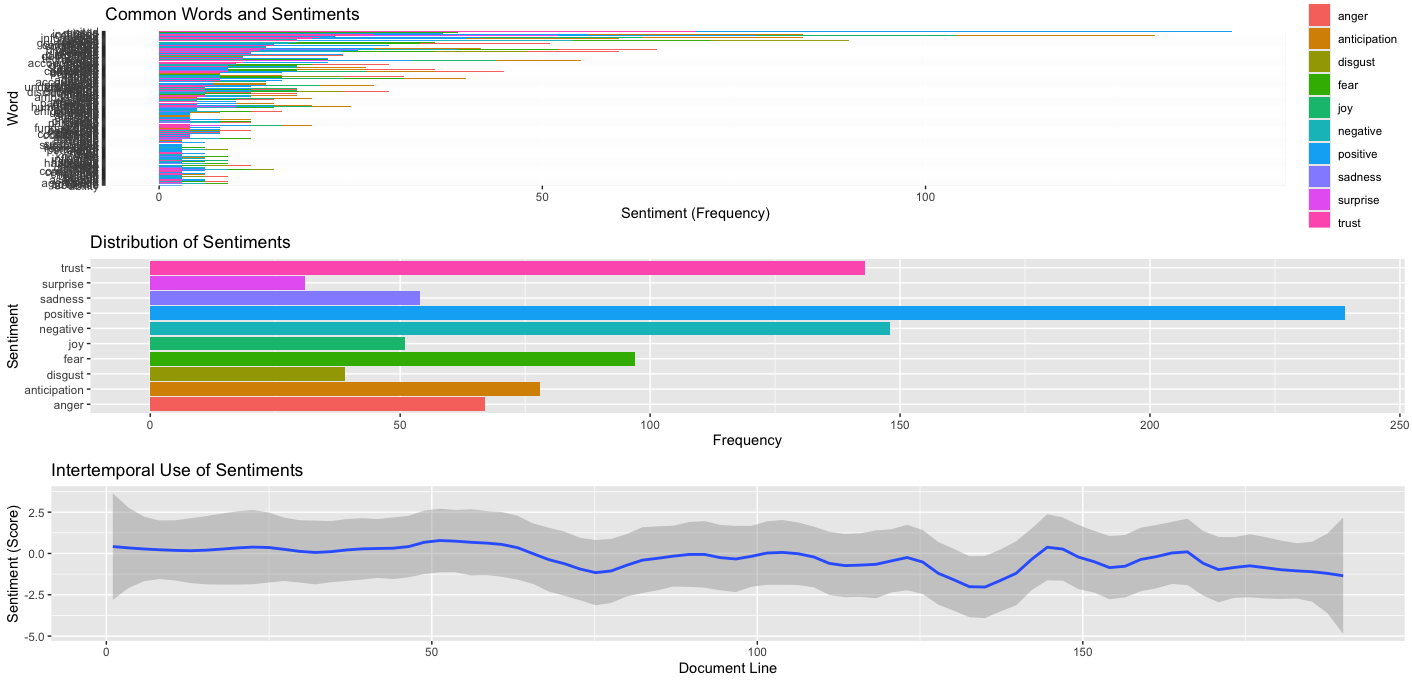
US-DPRK relations have been bordering on war for decades now. Despite small gains during Trump’s first administration, relations have continued to dwindle, best represented by US efforts to communicate with North Korea through the recently reopened Swedish embassy. The US has imposed various sanctions on North Korea and on other players in the purported “Axis of Upheaval,” including Iran and Russia. The perennial fear over the security of US-allied South Korea has claimed much of Washington’s attention. Before the Russia-Ukraine War, sentiment about North Korea primarily concerned its recent test-launch of a new missile or a recently threatened nuclear action. After the Russia-Ukraine War began, North Korea’s increasing support for Russia, culminating in North Korean troops fighting alongside Russians in the Russo-Ukrainian war, has marked a decline in sentiments within Washington toward North Korea. Still, Washington stands by a “complete denuclearization of the Korean Peninsula.”
Concluding Impressions
Both Washington and Beijing, at least in rhetoric, attempt to position their respective stances as morally superior. A prospective world war would be fought along lines of ideology, informational sway, and familiar balance-of-power politics. Captured in our data is the stark divergence of sentiments between Washington and Beijing toward each flashpoint; mirroring most of our increasingly tense feelings toward US-China relations which have emerged as the defining quagmire of our age. Yet, we don’t want to paint an entirely bleak picture: war is not entirely unavoidable. One can remember a time in 1969 when American and Chinese ambassadors met without formal diplomatic relations for the first time in two years over a cup of tea. And while these talks in Warsaw did little to achieve formal agreements, they served as an avenue of communication that made miscalculations less likely and relieved tensions in East Asia. We believe this face-to-face communication—which enabled both sides to perceive each other’s innate humanity—is much needed today.
This piece is a reproduction from its original issue in Hemispheres Volume 48 Issue 1. Read more here.
 Hemispheres