
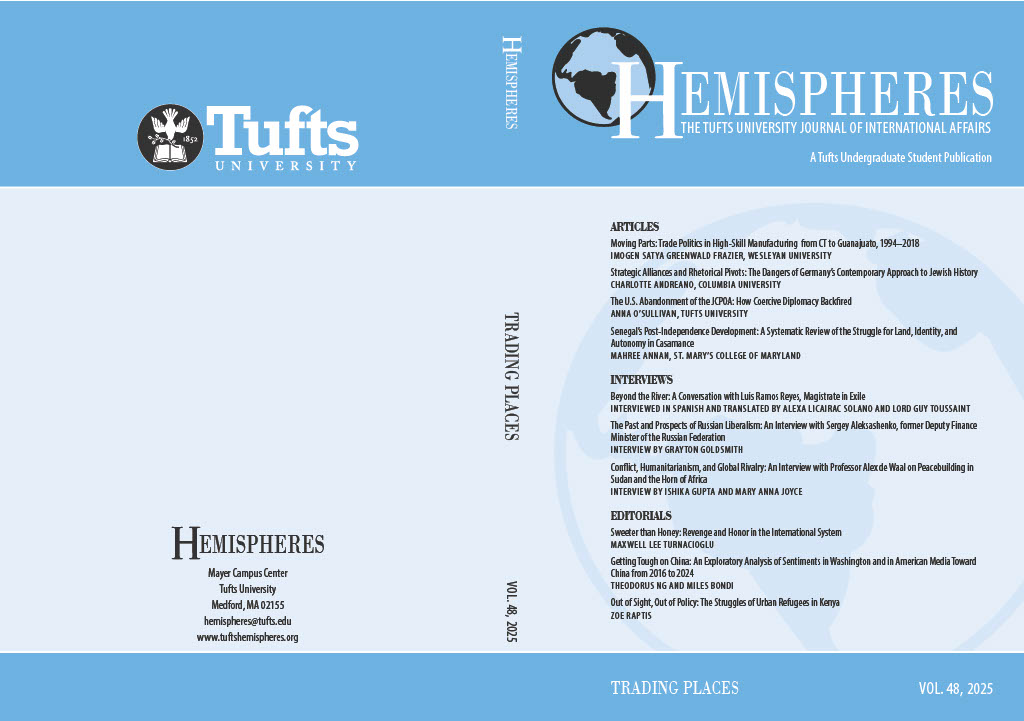
View the latest issue of Hemispheres (vol. 48, no. 20) here or by clicking the image below. Congratulations to this year’s four authors! The following letter from our executive board offers a prolegomenon to the journal and annual theme, “Trading Places.”
As students of international affairs, power is the language we first learn to speak. In introductory classes or seminar discussions, we continuously scrutinize structures of authority, influence, and control that shape interactions on the world stage. We are taught that—if there is a common thread underlying dominant frameworks of international affairs scholarship—it is the characteristic anarchy of the international system which leaves a vacuum for emergent hierarchies. While some scholars see in these hierarchies an inescapable state-centric structure, others choose to privilege normative interpretations. This year, our contributors lay bare shifts, inversions, and disruptions in manifestations of these hierarchies. The second issue of our 48th volume takes the theme “Trading Places” beyond traditionally intuitive analyses of great power politics and security studies in international affairs. Instead, it investigates often overlooked shifts of hierarchies in socioeconomic, electoral, diplomatic, and postcolonial spheres.
This is not to understate how important recent developments have been for those traditional concerns. The past year saw a series of significant realignments in global power structures. In stark contrast to the previous administration, President Donald Trump resumed his confrontational approach to U.S. alliances, casting doubt upon long-standing security commitments in Europe and Asia, openly threatening NATO partners with funding cuts, and undermining the sovereignty of neighbors Canada, Mexico, and Greenland. Meanwhile, his administration has escalated trade tensions with China, reinforcing economic decoupling efforts. The BRICS bloc continues to expand its influence, welcoming Indonesia as a new member in January of this year, following the 2024 additions of Egypt, Ethiopia, Iran, and the United Arab Emirates. This expansion signals a growing challenge to Western-dominated financial institutions. Additionally, the shutdown of major international aid mechanisms has come as a shock to communities throughout the Global South, exacerbating already vulnerable humanitarian crises. Amid the ongoing war in Ukraine, the European Union not only grapples with the looming threat to its physical security, but also with growing risks to its energy and economic stability. Finally, the Israel-Gaza war continues to send ripples throughout the international community as questions about who defines international justice are once again brought to the fore.
Our contributors offer myriad interpretations that together paint a picture of what the theme “Trading Places” might represent in the international system. While Imogen Frazier at Wesleyan University analyzes the fluctuation of worker perceptions in Connecticut and Guanajuato as NAFTA evolved overtime, Charlotte Andreano of Columbia University explores the rhetorical manipulation of Jewish history by the German far-right, highlighting a concerning inversion of post-World War II sociocultural power structures. From a diplomatic perspective, Anna O’Sullivan at Tufts University examines the U.S. withdrawal from the JCPOA, demonstrating the failure of coercive diplomacy and how it backfired in preventing Iran’s nuclear proliferation. Finally, Mahree Annan at the St. Mary’s College of Maryland investigates the extent to which inequalities rooted in political exclusion and economic exploitation affect peace management in critical rural geographies such as Casamance in southern Senegal.
Our interviews and editorials add yet another layer of novel perspectives on the theme. Magistrate-in-exile of the Venezuelan Supreme Tribunal, Luis Ramos Reyes, recounts his story of opposition to the Maduro regime, while former Deputy Finance Minister of the Russian Federation Sergey Aleksashenko sheds light on Russia’s fraught history with democracy. In addition, Professor Alex de Waal discusses peacebuilding and global power rivalry in the Horn of Africa. Finally, our editorialists examine the problematic concept of talionic justice in international law as invoked in the War on Terror; conduct a sentiment analysis of the first Trump and Biden administrations’ rhetoric toward China; and propose solutions to the urban refugee infrastructure policy gap in Africa, using Kenya as a case study.
This year has been invigorating for Hemispheres. Our second ever mixed-media annual magazine last fall featured over 30 opinion and explainer pieces from our staff writers, almost double the length of our inaugural magazine issue the year prior. After tapping into our alumni network and meeting with our founder Dr. Stephen Davis, our members were infused with a sense of dedication to the legacy and continuity of the Hemispheres mission—resolute since 1976:
Believing that international understanding is of paramount importance in an increasingly interdependent world, [Hemispheres] seeks to stimulate and serve student interest and involvement in the study of global affairs.
—Stephen Davis
With every issue, we seek to reaffirm this commitment.
In closing, the Editorial Board would like to extend gratitude to everyone who made this issue possible. A great deal of effort was put into creating, curating, and polishing this selection of exceptional undergraduate research, by both our authors and our staff editors. In particular, we would like to thank Luis Ramos-Reyes, Sergey Aleksashenko, and Alex de Waal for their stimulating conversations with our staff. As always, our hope is that this selection will prove thought-provoking and spark further informed global discourse that is so desperately needed in today’s polarized climate.
Yours,
Sam Sullivan, Co-Editor-in-Chief
Ishika Gupta, Co-Editor-in-Chief
Grayton Goldsmith, Managing Editor
Zoe Raptis, Managing Editor
 Hemispheres