
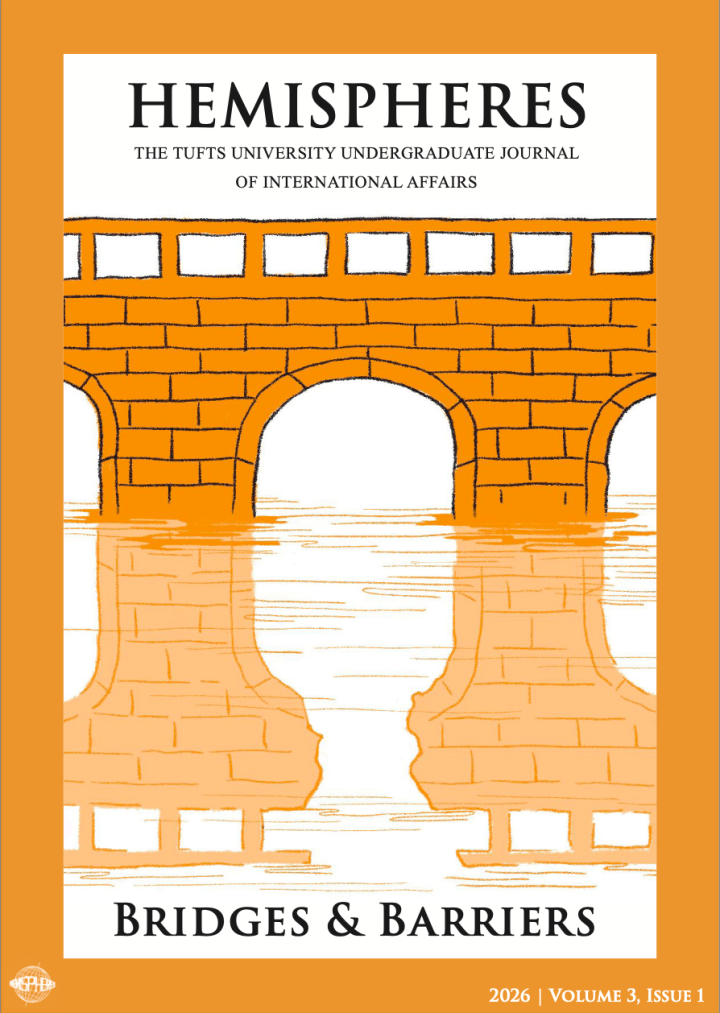
The 2026 issue of the Hemispheres Magazine is now available to view at this link or by clicking on the magazine cover below. The Editorial Board extends warm gratitude to all who helped in making this publication possible, including our ever-expanding team of skilled staff writers and our cover artists.
As the Hemispheres magazine continues to evolve, it’s exciting to see that the topics and mediums included continue to grow with it. We hope that, no matter your area of interest, in this “Bridges and Barriers” edition of the magazine, you’ll find something that sparks your curiosity.
Below is a preamble from our editors on this new issue:
Letter From The Editors
This year’s issue of Hemispheres is situated within a global landscape marked by deepening divides alongside unprecedented forms of connection. The theme “Bridges and Barriers” investigates both the pathways that foster cooperation and the structures of separation shaping international affairs today. This semester, our membership has doubled, accompanied by a noticeable rise in campus awareness of Hemispheres. This growth underscores the magazine’s role as an important platform for Tufts students to engage with and discuss issues in international affairs. In response to this unprecedented demand, our editorial team expanded the publication to include a greater number of pieces, reflecting the vibrant intellectual energy and demand for thoughtful student analysis of global challenges. We remain steadfast in our mission to make international relations scholarship accessible through our magazine, and this issue offers our most diverse range of articles yet—written by contributors from across majors and disciplines who seek to foster dialogue on the pressing issues shaping our world.
This year’s geopolitical moments reflect the very heart of “Bridges and Barriers.” In the first twelve months of his second term, President Donald Trump introduced a series of sweeping tariffs that reshaped U.S. trade relationships, altering key partnerships and impacting global import dynamics. Meanwhile, other countries have forged decisive trade agreements like the Comprehensive and Progressive Agreement for Trans-Pacific Partnership and the African Continental Free Trade Area, facilitating cross-border cooperation and offering new avenues for economic growth. As some countries have strengthened ties, others have intensified rivalries. Both the Israel-Hamas conflict and the Russia-Ukraine War demonstrate the pervasiveness of international antagonism, despite attempts at making peace. However, hope is not to be lost; international support for a ceasefire in Gaza continues to grow, and NATO has strengthened its ties in response to Russia with a successful summit at The Hague and further commitments to the alliance. There has also been an increase in female presence in international positions of power, from Claudia Sheinbaum Pardo assuming presidency in Mexico to Sanae Takaichi becoming the first female Japanese Prime Minister, among others.
Our staff writers worked tirelessly this fall to curate a collection of pieces that reflect the breadth and nuance of this year’s theme. The issue features a wide range of formats—from traditional op-eds and analytical explainers to data-driven graphics, interviews, and creative reviews—each bringing a distinct lens to “Bridges and Barriers.” Many contributors approached the theme through questions of security, examining hybrid threats such as conflict in space and the intensification of Russia’s drone campaigns. Others adopted comparative perspectives, contrasting corruption in Nepal and Thailand, as well as exploring border shifts in the Middle East. This semester also saw a heightened interest in climate and global health. Pieces explore a multitude of topics, ranging from climate injustice in Asia to the implications of the dismantlement of USAID, underscoring how environmental and public health crises both transcend and reinforce geopolitical divides. Our human rights contributors tackle topics ranging from Cameroon’s anglophone crises to the coups in Myanmar, while our economics writers delve into questions of tariffs, the AI scramble, and quantum computing. Finally, several articles probe public opinion and political culture more directly—such as a survey of the Tufts community on gender and global leadership—as well as a documentary review examining the devastation of Mariupol, offering a powerful reflection on the human cost of conflict. Together, these pieces highlight the intellectual curiosity and the spirit of collaboration that define Hemispheres, with many articles produced through close teamwork among writers.
As you flip through the pages of this year’s issue, we hope the ideas, analyses, and narratives presented here prompt you to think critically about the bridges being built and the barriers being reinforced across our world. Whether or not you study international relations, we invite you to engage with these conversations, challenge your assumptions, and consider how you, too, can help shape a world where connection outweighs division.
Before you begin reading, we want to remind you that the statements expressed in this magazine are the views of individual authors and do not reflect the opinions of Hemispheres as a nonpartisan, non-ideological club committed to providing an open platform for intellectual discourse and academic publication.
Yours,
Zoe Raptis, Editor-in-Chief
Arman Kassam, Managing Editor
Kristina Megerdichian, Managing Editor
Eva Zeltser, Managing Editor
For endnotes, please visit the Hemispheres website at https://tuftshemispheres.org.
 Hemispheres