
By Jessie Levine and Thuptim Appleton
The Thai government has long grappled with issues of corruption. Increasingly, Gen-Z has been utilizing social media to scrutinize government misconduct, particularly the ever-present corruption. Since its popularization in Thailand, social media has played a key role in politics, but this year, it sparked a new nationalist facet.
To further understand this dynamic, it is necessary to outline Thailand’s political landscape. The nation operates on a parliamentary system, and the party divide has evolved to reflect generational discrepancies: Gen-Z voters generally support liberal reforms, while older generations tend to favor the more traditional, conservative parties that uphold royalist values. However, a large portion of the population does not feel strongly toward either side, which only broadens political confusion.
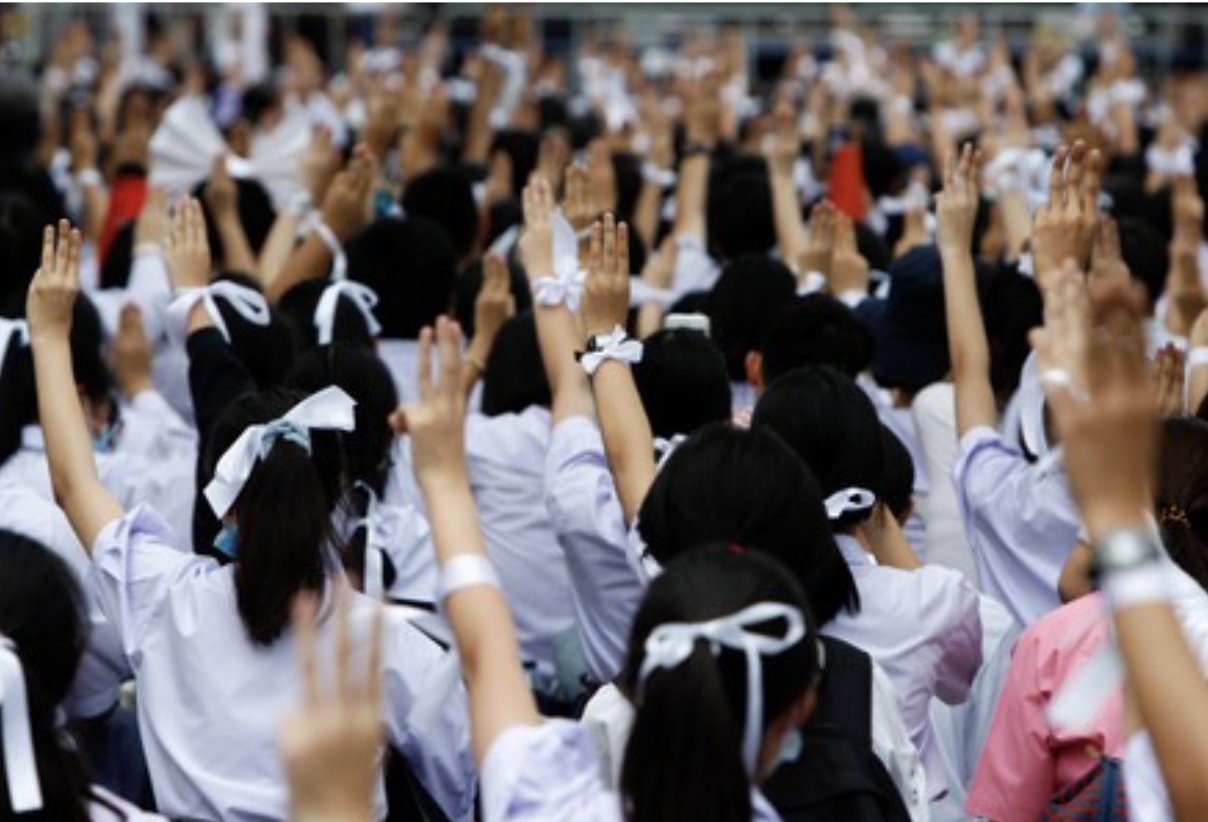
The first wave of widespread Gen-Z protests occurred in 2020, when citizens spoke out against then Prime Minister Prayut Chan-o-cha and called for overall reform of the royal family’s power. Undoubtedly, the most prominent symbol of the movement was a three-fingered salute (pictured above), made popular by the Hunger Games franchise. In the fictional Hunger Games world of Panem, the salute was performed by oppressed citizens subject to totalitarian rule. Through Thai social media use, the symbolic image gained mass popularity, marking a convergence of overlooked corruption in Thailand with pop culture references from the West:
“By using a symbol that is popularly understood in the U.S. and globally, it’s a way of encouraging people to make that connection between something they do understand, which is Hunger Games, and try to start to say, ‘Wait a minute, is that also what’s going on in Myanmar?’ So, absolutely it’s a way to draw attention around an issue.” – An Xiao Mina, Internet Social Movement Researcher.
While these protests eventually subsided, they reemerged in 2025 following the controversies surrounding former Prime Minister Paetongtarn Shinawatra. The Shinawatra family is well known for the three prime ministers it has lent to the Thai Parliament. Paetongtarn was recently in a scandal for a leaked audio clip with President Hung Sen of Cambodia. The public viewed her interactions as unnationalist and saw her words as trying to appease Cambodia instead of strengthening Thailand. As this controversy came to light, additional instances of corruption surfaced, such as budget transfer allegations towards Paetongtarn and the ongoing Alpine Golf Course controversy. These events generated significant backlash, culminating in protests against the Thai government and the Boonsin Phenomenon.
Lieutenant General Boonsin Padklang is credited with the nationalistic movement seen in today’s youth. Not belonging to an explicit party, Boonsin reflects the ideals of the 2020 protests and has gained Gen-Z Thai support for the border dispute with Cambodia. The military official has taken to flying military planes around the country, visiting various students and schools as a way to propel Thai patriotism. This is now referred to as the Boonsin Phenomenon.
These instances reflect the growing influence that Thai youth holds over politics. Whatever the future holds, there is no doubt that Gen Z will be the cause of it.
Gen-Z is also making a stand in Nepal. While corruption has run awry in the nation for years on end, decisive action was taken against it in September 2025. After Prime Minister K.P. Sharma Oli—who has long maintained a dominant hold on power in Nepal—banned 26 social media applications, including Instagram, Facebook, and YouTube, widespread unrest followed.
The implications of the social media ban run deeper than previously understood. For most Nepalis, social media is their gateway to communication, livelihood, and news. Critics have proclaimed that Prime Minister Oli’s social media ban limits press and freedom of expression by removing main channels of transmission. Many businesses, large and small, promote through social media; thus, by banning applications,their livelihoods are in danger. Nuance is added when looking at the recent statistics of Nepal’s economy. While the GDP grew four percent in 2024, a majority of citizens are either unemployed or hold insecure job status, further proving Nepal’s wealth disparity.
However, these riots were not solely the result of the government’s ban on social media. Rather, it was the final straw in what Nepali Gen-Z perceived as an endless cycle of corruption and silencing. Throughout the generation’s entire lives, there has not been a true democracy in Nepal; instead, there has been a revolving door of the same few people in power, none of whom are close in age to the protestors. This same group of people has had numerous corruption allegations, including that of illegal land grabs, refugee scams, and numerous bribes for political favors.

A main focus of the protesters’ anger lies in the concept of “nepo babies.” Nepo babies, or children of corrupt politicians, often flaunt their wealth on social media. The photo above pictures Saugat Thapa, the son of provincial minister Bindu Kumar Thapa, beside his 20 Christmas gifts, all clad in name-brand designer boxes such as Gucci and Louis Vuitton. This image sparked outrage amongst Gen-Z Nepalis, who viewed the post as a blatant reminder of the wealth gap that divides the few wealthy Nepalese from the rest of the population.
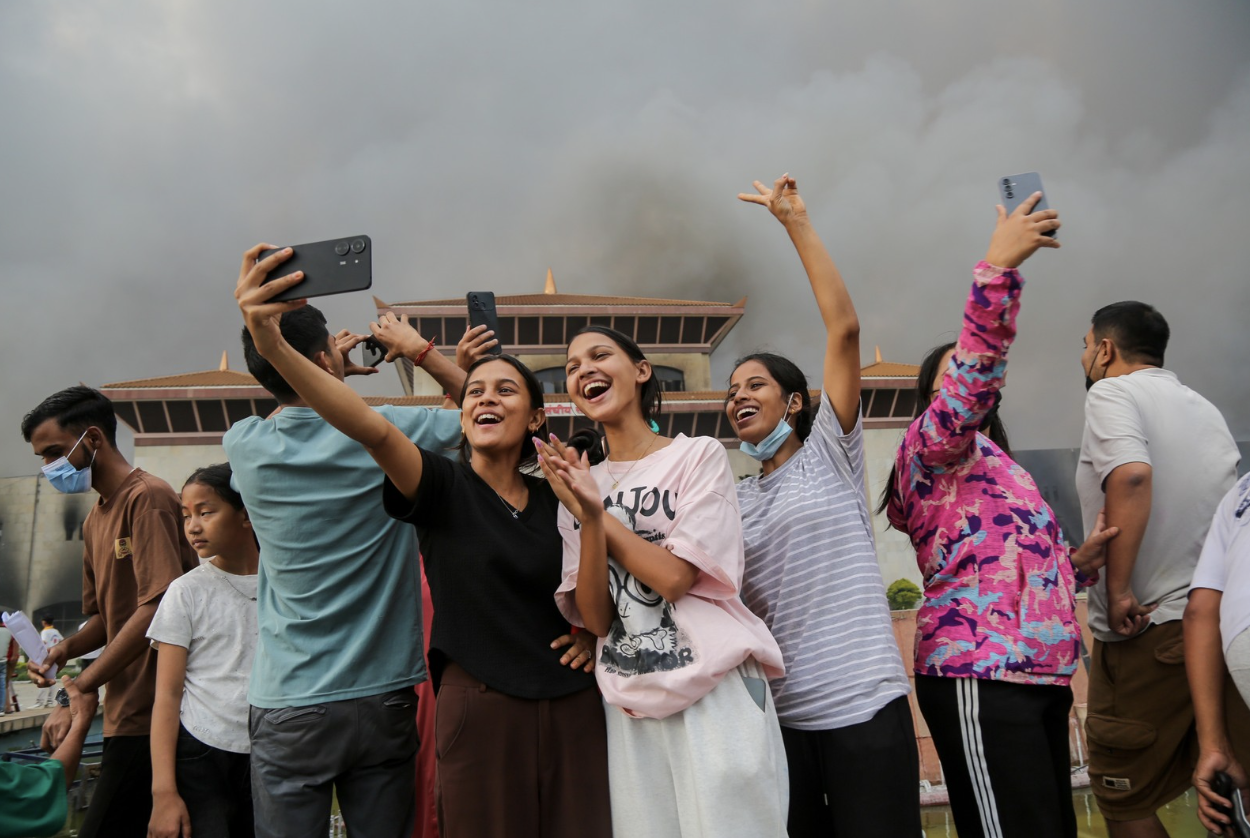
As depicted above, decisive measures against corruption have been taken, such as the burning down of the parliament building, which, as a result, terminated Oli’s reign of power.
While the Gen-Z protests were successful in their task of ousting the previous government, there now exists a power vacuum within Nepal. The government is currently headed by interim Prime Minister Sushila Karki, who is trusted by all parties as an anti-corruption symbol. However, she has publicly said that she does not want the role. The public is now awaiting general elections that will be held in March 2026; yet, there is widespread belief that the Nepalese Gen-Z protests will not last, as corruption has posed an ongoing problem since Nepal’s inception. A Gen-Z protestor figurehead named Aditya, with an optimistic mentality, has stated, “We are continuously learning from the mistakes of our previous generation,” he says firmly, “They were worshipping their leaders like a god.” In attempts to reverse this idolatrous treatment, Gen-Z protesters have the opportunity to enact real change.
 Hemispheres