
By Jack Srihari and Nadsen Chavannes
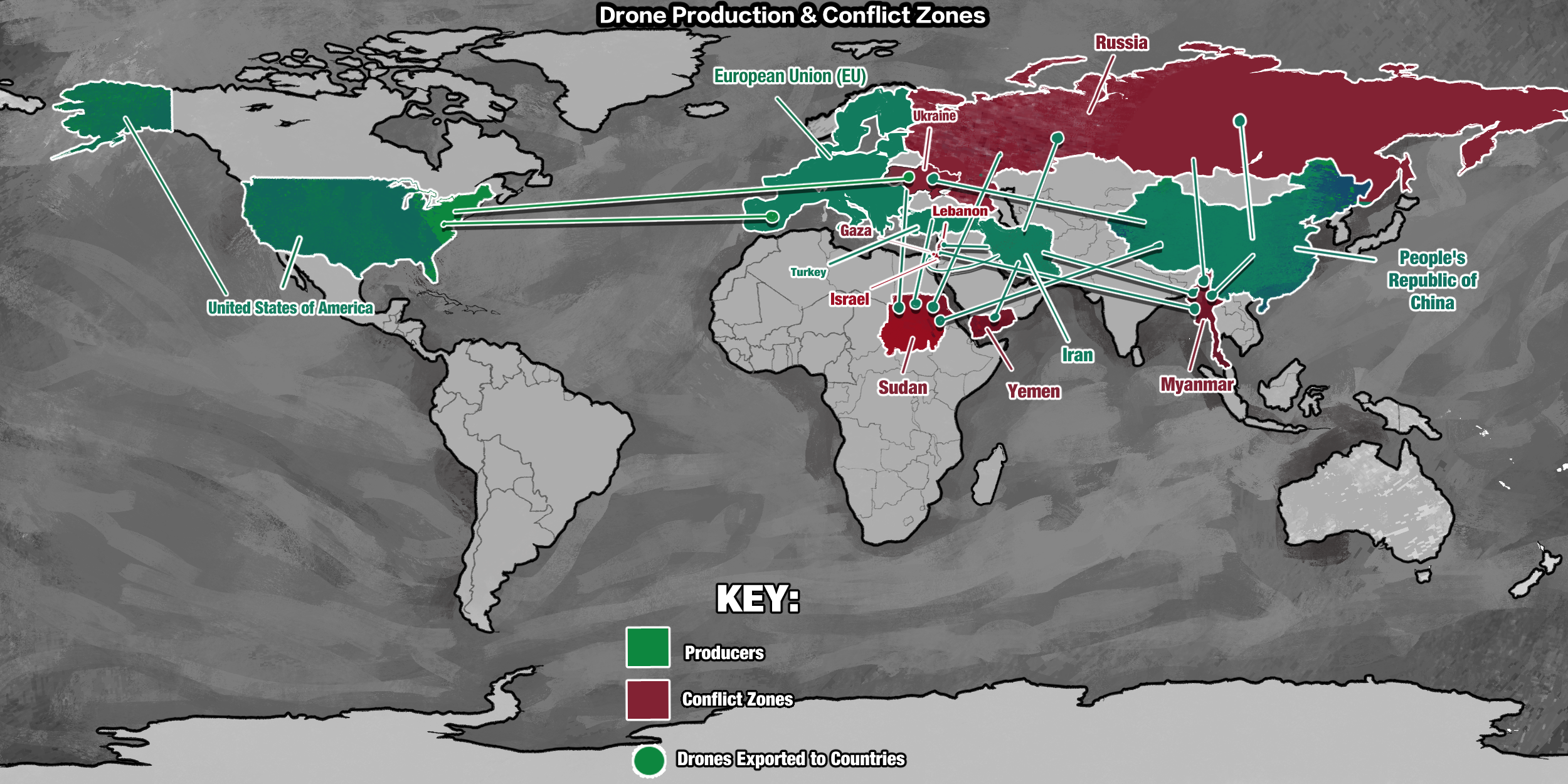
In the last five years, drones have become a ubiquitous weapon on battlefields across the world, from the jungles of Myanmar to the dunes of the Sahara Desert to the plains of Ukraine. However, the majority of these weapons originate from a small group of countries, most notably Iran, Turkey, the United States, Russia, China, and Ukraine. They have become tools not just for war, but for world powers to exert their influence around the world.
Today, drones act as one of the primary tools for states engaging in proxy conflicts around the world. Their cheap cost of production, high level of battlefield impact, and ability to be shipped stealthily enable states to participate in wars they might once have avoided. As a result, drones from a small handful of countries are now flooding nearly every conflict zone around the world. This article aims to shed some light on the impact of these drones where they are being used, and who is supplying them, while providing context on the conflicts they are helping to shape.
Myanmar:
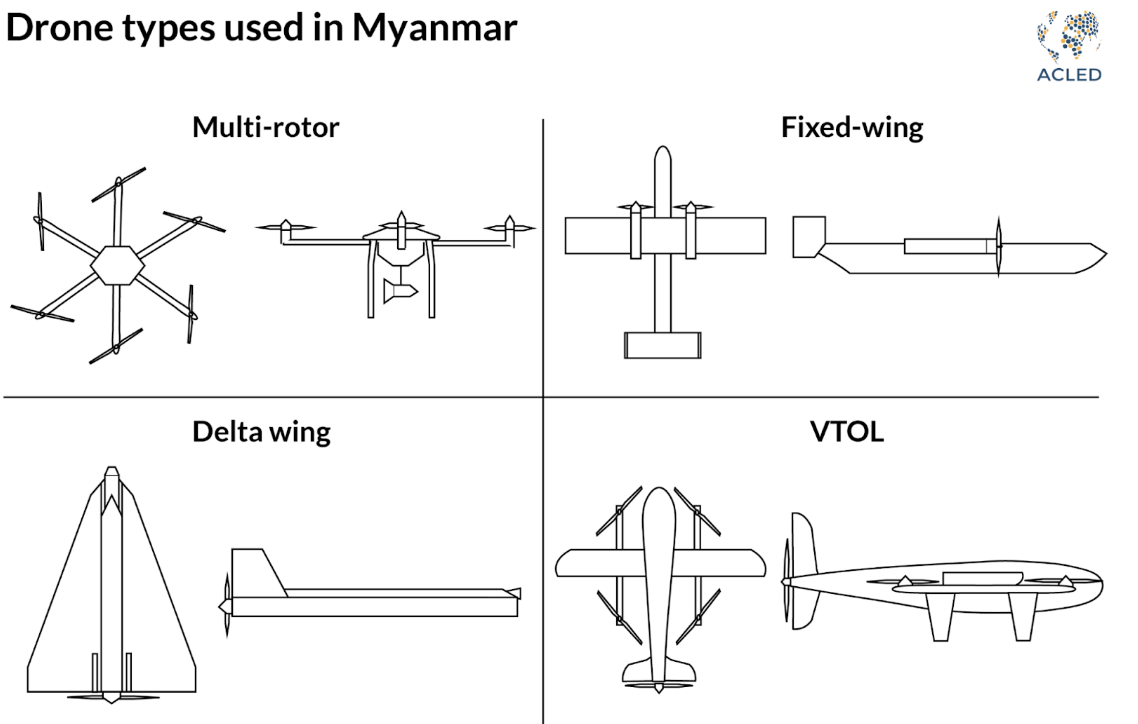
The current crisis stems from armed resistance to the 2021 military coup, reigniting a bloody civil war. Initially, the rebels lacked any source of air power. In an attempt to level the playing field with the government forces, each of the rebels began investing in drone technology. Using a mix of locally produced, retrofitted commercial drones, and some foreign made drones, the rebels were able to effectively control the skies, enabling them to overwhelm government forces. However, in early 2024, the military had learned from the resistance and began the wide-scale adoption of drones. By the start of 2025, the military had surpassed the rebels in terms of the number of drone strikes and began jamming the frequencies used by the resistance, stopping them from using most of their drones. The majority of their weaponry comes from Russia and China, enabling them to prolong the conflict into a stalemate. China has been supplying whichever side they think currently has the advantage in order to secure crucial mineral and investment deals after the war ends.
Sudan:
Sudan’s civil war has turned into a drone proxy conflict as several foreign powers have shipped in drones with the hope of getting trade and port deals with the two factions. Sudan sits on the Red Sea, one of the most vital maritime trade routes, and so nations hope that by supporting one of the two factions they would be able to secure a naval base along the route. This current conflict started in 2023 after a paramilitary group, Rapid Support Force (RSF), tried to oust the ruling Sudanese armed forces (SAF). By 2024, both sides had begun using foreign-made drones in their military operations. The SAF is using an eclectic mix of drones: Turkish drones from Egypt, Russian and Iranian designs, and Ukrainian supplied drones originating from multiple countries. On the other hand, the RSF have been using Chinese drones supplied by the UAE and their remaining supplies of Russian drones. Both factions have also begun limited domestic production of their own designs. Drones have drastically changed the conflict’s landscape by allowing the factions to launch strikes on cities deep into each other’s territory, and played a huge part in the battle and massacre of Al Fasher.
Russo-Ukraine:
The Russo-Ukrainian war has driven the extensive development and manufacturing of drone technology globally ever since Russia’s invasion of Ukraine in 2022. From the overwhelming aerial power Russia displayed at the beginning of the invasion, it was predicted by military analysts that Russia would quickly seize control of airspace. However, with the help of Western’s military aid, Russian aircrafts were unable to make clear airstrikes throughout the European country.
At the beginning of the war, Ukraine relied heavily on larger drones like the Turkish TB2 Bayaraktar to nullify Russian air forces.14 However, as the war continued, Russian air forces were able to detect these types of drones and neutralize them more effectively. Due to this, Ukrainian forces decided to shift from the larger air-models to a smaller drone technology. This pushback led to the inability to break through either country’s air defenses, causing both Russian and Ukrainian forces to rely more on long range artillery, especially high-tech drones. Prior, the equipment used would become very easy to track, nullifying the stealth factor needed to carry out attacks with the technology. This would shift both country’s battle strategies into utilizing smaller-scale attacks with this newer weaponry. On both sides, the advance As a result, the war’s relentless use of aerial technology led to the development of newer drone technology.
The use of drones in the Russo-Ukrainian conflict has demonstrated their effectiveness on the battlefield. Their smaller, less costly operations made it particularly appealing to the military, along with their advanced detection protocols and availability. The first-person view (FPV) drones also have higher endurance, utilizing its longer battery life in carrying out precise strikes within enemy territory. These advancements provided Ukraine with immense military power. Ukraine was also provided with aid from multiple countries and organizations — from the U.S alone they received 175 billion USD, used to help through military related operations. Most countries involved in NATO have also played a large role in Ukrainian aid. This aid would consist mostly of budget support, weapons, and humanitarian aid. Through foreign military aid and crowdfunding for recreational engine products, Ukraine continued to create FPV drones with lower expenses. As a result these FPV drones continue to play a crucial role in aiding the Ukrainian military’s arsenal, that weren’t possible with prior tactics.
 Hemispheres