
By Kieran Doody
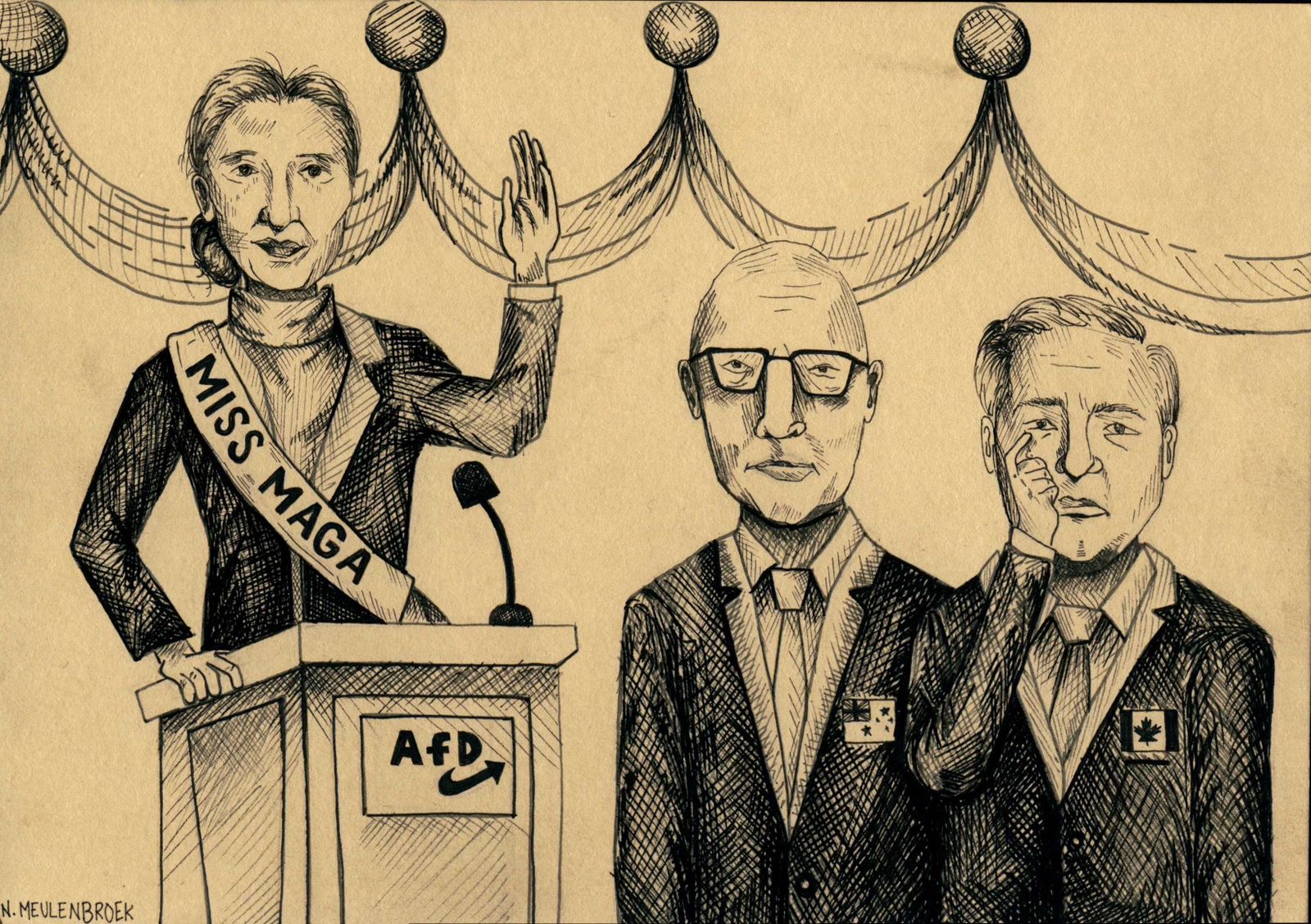
Halle, Germany – January 25, 2025:
In a breezy banquet hall, thousands of people are bathed in overwhelming blue spotlights as German flags jut out from a sea of black silhouettes. On stage, drowned out by the crowd’s roaring cheers, Alice Weidel, the provocative yet charismatic leader of Germany’s Alternative for Germany (AfD), points to a large screen. Resplendent in her signature suit and stern demeanor, she is surrounded by a colonnade of German flags as a flash of light floods the room and a man’s face appears. Distorted by the camera angle, Elon Musk resembles “Big Brother” in 1984.
Five days after performing a Nazi salute live on U.S. television, and two days before Holocaust Remembrance Day, Elon Musk begins to speak, urging Germans to move on from their “past guilt.”1 This unprecedented involvement of American political figures in German politics, including American Vice President JD Vance’s meeting with AfD leadership, coincided with the party’s unprecedented support in Germany’s 2025 Federal Elections.2 In fact, despite being labelled as a right-wing extremist group by the German Federal Office for the Protection of the Constitution, the AfD doubled their vote share.3 They became the second largest party in Germany’s Bundestag, gathering a broad coalition of disaffected voters.4
German voters, focused on internal affairs, namely an energy crisis and a sluggish economy, turned to right-wing populism.5 However, in nations like Canada and Australia, which have directly confronted Trump’s chaotic foreign policy, one begins questioning the viability of the “MAGA persona.” Within these nations, a silent majority has formed, an eclectic ‘rainbow’ coalition composed of recent immigrants to business executives. Contentedly snoozing under the safety of the U.S.-dominated liberal world order, it is only a matter of time before this silent majority wakes up and demands to be put back to sleep.
Across the world, a few months later, in a similar convention hall, there is a stark contrast in emotion. Australian opposition leader, Peter Dutton, delivers an early concession speech to a subdued crowd of supporters. Though his right-of-center coalition led the polls in the months preceding the campaign, the incumbent, center-left Labor Party, led by Prime Minister Anthony Albanese, won in a historic landslide, leaving Dutton as the first opposition leader to lose his seat.6 Antony Green, a well-respected Australian psephologist, attributes this sudden reversal of fortunes to three main factors: Albanese’s party running a “brilliant” campaign, Dutton’s “dud” campaign, and voters’ concerns over instability in Trump’s second term.7 These three components are closely correlated, as Albanese presented himself concretely against Trump, whereas Dutton embraced the MAGA persona, adopting more populist rhetoric and aligning himself with Trump’s geopolitical objectives. The verdict of the Australian people was apparent: Dutton lost significant support among immigrant Australians, namely Chinese-Australians troubled by Dutton’s hawkish, Trump-like stance on China; women; and affluent Australians, who opted for more moderate independent candidates.8
Within America, Trump’s defiant style of populism is a proven potent political force. However, for his Canadian neighbors who have directly grappled with the harsh reality of Trump 2.0, this boon quickly sours into detriment. Despite facing inevitable electoral annihilation, Canada’s Liberal Party, led by newcomer Mark Carney, managed to close a 24 percent polling deficit to win a fourth term over conservative Pierre Pollievre.9 Pollievre, who ran on slogans such as “Axe the Tax,” “Canada First,” and “Common Sense,” brought a Trump-style campaign to Canada, focusing on the cost-of-living and the economic woes of working Canadians. Nevertheless, he met his match with Carney’s stability-focused anti-Trump and anti-tariff “Team Canada” message. While conservatives gained support among younger voters focused on the cost of living, the Liberals responded, winning older and more affluent Canadians put off by Trump-like policies.10 In short, a persona of stability and national unity trumped one of MAGA and populism.
 Hemispheres