
By Eitan Cohen
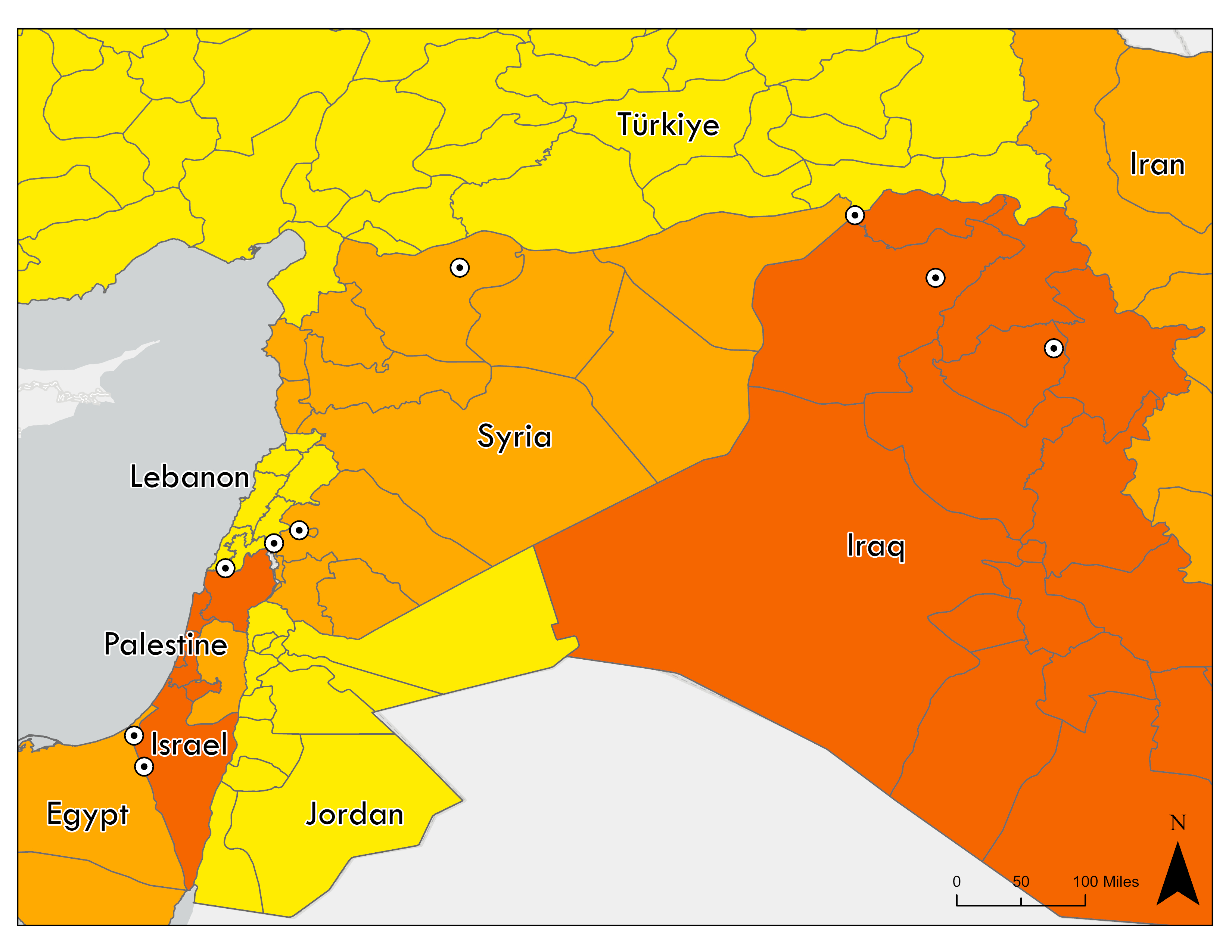
Borders around the Middle East have become focal points of power struggles and bloodshed over the past year. While none of these borders have been officially moved or altered, the way they operate has changed. Border zones around the Middle East are being used to fight proxy wars, project force, and prevent dangers before they reach their citizens. The result of these struggles is a region where borders do not merely create boundaries between countries, but rather dictate where and how nations fight.
Israel, Gaza, Lebanon, Syria, and Egypt
Nearly every one of Israel’s borders has seen activity in the last year. In Gaza, Rafah and other crossings have become militarized barriers where only military personnel can travel. Before the October 7th attacks, there were 17,000 Gazans with work permits for Israel, now there are zero. This is one way the border became completely sealed. In Lebanon, thousands on both sides have been displaced after Israeli airstrikes and Hezbollah rockets. Israel also launched a ground invasion into Lebanon, but later signed a ceasefire, withdrawing its troops. In Syria, Israel has been conducting airstrikes on Hezbollah and Iranian targets, specifically around the Israeli-Syrian border, the Golan Heights, and the Syrian capital of Damascus. Israel maintains that the goal of these campaigns is to stop terrorism rather than increase its territory. Israel also accused Egypt of breaking the 1979 peace treaty, where Egypt agreed to limit its troop presence on the Israeli-Egyptian border. Israel accused Egypt of stationing too many troops close to the border, further increasing tensions with Egypt.
Türkiye, Syria, Iraq
Türkiye has been a part of multiple operations abroad. During the fall of the Assad regime in December 2024, Turkish forces launched attacks against Kurdish freedom-fighting groups in northern Syria. Türkiye claims these operations were required for national security, but others believe it was to prevent Kurdish groups from acquiring power in the new Syrian government. Türkiye also launched drones and raids that targeted the Kurdistan Workers’ Party (PKK), another Kurdish militant group, this time in Iraq’s Kurdistan region. These operations show how the line between cross-border control and counterterrorism has become blurred in Türkiye’s war against Kurdish freedom-fighting groups.
Syria, Iraq
The Iraqi-Syrian border, an area that was loosely controlled by Islamic State remnants and militias supported by Iran, has also been unstable. One of these militias attacked a U.S. base in Jordan, killing three American soldiers. In response, the U.S. attacked, launching rockets towards these militias in February 2024. The Iraqi-Syrian border remains a hotspot with both governments claiming jurisdiction over it.
Lebanon-Syria
The new Syrian government and Lebanon have resumed border negotiations to restrict militia and smuggling movements.
Iran-Iraq:
In June 2025, Iran attacked Kurdish groups in northern Iraq with artillery and drone strikes along the Iraq-Iran border.
Conclusion
Across the Middle East, borders have remained central to how states think about security. These borders have shifted from areas of hostility to low-grade warzones surrounded by conflict. Borders have become increasingly militarized and continue to be hotspots of government or proxy conflicts.
 Hemispheres