
A Look into the U.S.-China Tech War
By Ashley Lee
In just two decades, China has transformed from a developing country, with a significant portion of its population living in poverty, to one of the world’s largest economies and leading technological powers. This transformation, driven primarily by its massive labor force, export-oriented manufacturing, and foreign direct investment, has propelled China to become the world’s second-largest economy, second only to the United States. With the country’s “Made in China 2025” initiative, China seeks to further upgrade its industries and become a global leader in advanced technology sectors, moving away from predominantly being a producer of cheap low-tech goods. In 2015, the announcement of the plan sparked significant backlash from the U.S., with apprehensions focused on the potential damage to American industry and the likelihood of unfair trade practices, including subsidies to Chinese companies and forced technology transfers. Concerns also revolved around the potential risks posed to the U.S., encompassing cybersecurity, supply chain vulnerabilities, and military applications, stemming from China’s dominance in critical technology sectors.
In response to U.S. concern, the Trump administration imposed tariffs in 2018 on a wide range of Chinese goods to address trade imbalances and perceived unfair trade practices, marking the beginning of a trade war with China. The U.S. government also imposed restrictions on Chinese technology companies operating in the U.S., such as Huawei, WeChat, and TikTok because they pose an “unacceptable risk to national security,” as stated in the Secure Equipment Act. By implementing stricter export controls on critical technologies, particularly semiconductors, to China, the U.S. made clear that it not only wants to prevent China from “spying” but also curb China’s ability to access advanced technology and high-end computing power.
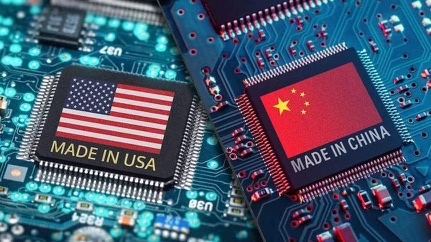
Although the ongoing tech war between the U.S. and China began as a trade dispute, it has broadened into a larger contest for dominance in core technologies such as semiconductors, 5G, and artificial intelligence (AI). Semiconductors, the fundamental building blocks of modern electronics and technology, are crucial for not only consumer electronics but also data centers, telecommunications, and defense systems.. Recognizing the strategic importance of semiconductors in developing advanced military technologies, both the U.S. and China have been working to develop their domestic semiconductor industries to reduce dependence on foreign suppliers, mainly Taiwan, South Korea, and Japan. The U.S. has imposed export controls on certain semiconductor equipment and technology to limit China’s access to cutting-edge chips, while China has invested heavily in its semiconductor industry, establishing initiatives like the National Integrated Circuit Industry Investment Fund (or the “Big Fund”).
Despite China’s large investments in its semiconductor industry, the U.S. still undoubtedly has the upper hand in the sector, as virtually every microchip around the world was either designed with American-made software, produced using American-made equipment, or inspected with American-made tools. Even though U.S. firms manufacture only about one-tenth of the microchips sold across the world, a group of U.S. companies control all of the higher levels of the supply chain. Consequently, the U.S.’ export controls on microchips are all the more devastating for China, significantly disrupting supply chains and hindering China’s ability to compete globally in chip manufacturing.
Along with semiconductor chips, AI chips have been another focal point in the U.S.-China tech rivalry. AI can automate many processes, enable data-driven decisions, and deliver customized experiences, thus it is expected to disrupt and transform various industries. As a result, both China and the U.S. view AI as the key to maintaining a stronghold in various industries. Both countries have implemented AI policies and strategies to support research and development, but regulatory approaches and policies related to AI, like data privacy, have become areas of contention between the U.S. and China. The U.S. government has also imposed export controls on AI technologies that have potential national security implications and placed restrictions on Chinese tech companies operating in the U.S. Despite these areas of contention, the U.S. and China have recently agreed to work together with at least 25 other countries to mitigate potential risks that may arise with the progression of AI, especially those in the domains of cybersecurity and biotechnology. By signing the Bletchley Declaration at the UK AI Safety Summit, the two countries, along with the EU, India, Germany, France, and many other countries, have agreed to oversee the evolution of AI and ensure its safe technological advancement.
While these collaborative initiatives reflect a partial alignment of interests between the two nations, the future of the great tech rivalry between the U.S. and China is undoubtedly complex. Although the competition seems likely to persist as both nations continue to fight for technological leadership and economic power, opportunities for collaboration and cooperation will always remain in areas where mutual interests converge. The decisions made by the U.S. and China in the coming years regarding cooperation, competition, and diplomacy will shape the trajectory of this multifaceted rivalry, with consequences that will extend far beyond their own borders.
Ashley Lee is a sophomore at Tufts University studying International Relations and Psychology.
This piece is a reproduction from its original issue in Hemispheres vol. 47, no. 1.
 Hemispheres