
An Uncertain Future for the South China Sea
By Theodorus Ng
On October 22, 2023, a Chinese coast guard ship collided with a Philippine vessel in the South China Sea—once again bringing the country’s intimidation campaign there to a hilt. The BRP Sierra Madre was on a routine resupplying mission to marines stationed on Second Thomas Shoal; since 1999, the Philippines had grounded it on the submerged reef to assert its territorial claims. The antagonistic encounter was one of several this year. In August, China sprayed water cannons at two such resupply vessels; in February, it aimed military-grade lasers to temporarily blind Filipino sailors. Such sustained acts of intimidation reflect China’s increasing militarization of, and determination to assert sovereignty over, the SCS.
Ongoing disputes hinge on four geographic features of the SCS: the Pratas Islands, the Paracel Islands, Macclesfield Bank and Scarborough Shoal, and the Spratly Islands. The greatest contentions surround the Paracels in the north and the Spratlys in the south. China, Taiwan, and Vietnam claim both in their entirety, while the latter are subject to additional claims by the Philippines, Malaysia, and Brunei.

The maritime dispute has ostensible roots in China’s controversial nine-dash line, which it asserted in 1952 and formalized in 2009. Beijing asserts “indisputable sovereignty over these islands and their adjacent waters” and professes to be their first recorded discoverer. China’s demarcation encompasses approximately 62% of the SCS. It also overlaps with the Exclusive Economic Zones (EEZs)—200 nautical miles to which, under the 1994 UN Convention on the Law of the Sea (UNCLOS), the other Southeast Asian countries could lay claim.

Given the economic prospects of the SCS, the claimants seem more than willing to subvert international conventions. An estimated $3.4 trillion of commerce transits the sea each year, constituting a third of global shipping. Moreover, untapped resources abound. The US Energy Information Administration reports that the SCS contains about 11 billion barrels of oil and 190 trillion cubic feet of natural gas, with potentially more undiscovered. These staggering figures prompt claimants to treat territorial sovereignty in the SCS as indivisible.
Tensions in the SCS have flared periodically since China laid its claims in 1947. Armed combats raged against Vietnam’s navy in the 1970s and 1980s over the western Paracels and reefs in the Spratlys. This past decade, tensions have been the highest with the Philippines. Following a naval standoff in 2012, China seized de facto control over the Scarborough Shoal and began extensive land reclamation in the Spratly archipelago. Meanwhile, the Philippines sought arbitration under the UNCLOS. A tribunal ruled in 2016 that China had “no legal basis” for its claims to historic rights, which its 1996 ratification of the UNCLOS had implicitly revoked. It was also ruled that China violated Philippine sovereignty by interfering with their vessels and undertaking reclamation in the Philippines’ EEZ. China dismissed these rulings. It has continued creating artificial landmasses on which it stations military outposts with anti-aircraft and anti-ship missile systems.
Besides such international adjudication, China and the Association of Southeast Asian Nations (ASEAN) have been negotiating a code of conduct (COC) for the SCS since 2002. Observers are skeptical. Huong Le Thu, a senior analyst with the Australian Strategic Policy Institute, neatly summarizes their mistrust: “China has used the prospect of a COC as a Holy Grail to entice the region. The protracted process diverted their attention while Beijing advanced its strategic objectives.” Those objectives are China’s incremental militarization of the SCS and deployment of gray-zone tactics—hostile acts that come short of instigating conflict—to coerce other claimants into concession.
There is no clear course of sailing ahead in the South China Sea dispute. In such murky waters, scholars have strived to identify policymaking processes with solutions. Optimists hold that international institutions remain viable to constrain bellicose behavior, as they bolster norms of diplomatic cooperation. However, they could serve as merely temporary stopgaps until international pressures wane. Others suggest that tribunals should trace states’ intentions to act as sovereign, operating on the legal principle of à titre de souverain. These tribunals would determine, that is, which state best demonstrates its historical exercise of actual authority over the disputed territories. More suggest that claimant ASEAN states should convene on separate collective issues, such as overfishing and maritime law, before presenting a united front in negotiations with China. Such recommendations arise amid ASEAN’s increasing paralysis and China’s preference for bilateral over multilateral negotiations. Just as economic imperatives underlie the SCS dispute, however, so too do they guide regional cooperation. It behooves us to consider whether and how beholden claimants are to the regional economic hegemony of China, which naturally shapes their approaches to negotiation.
The US is implicated in recent disputes between China and the Philippines, should crises escalate to conflict, by its defense allyship with the latter. It serves the best interests of the international community and the Philippines if the US, now rather than later, credibly reaffirms its commitments to the Indo-Pacific and encourages international abidance by maritime rights. The key objective for all implicated actors should be to persuade China that its interests lie in upholding international maritime norms and laws, rather than undermining them.
Theodorus Ng is a freshman at Tufts University studying International Relations and Computer Science.
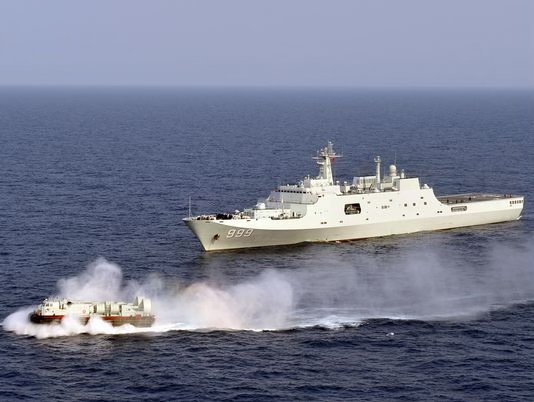
Image: The Chinese navy conducts drills in the South China Sea (Times Asi / Flickr)
This piece is a reproduction from its original issue in Hemispheres vol. 47, no. 1.
 Hemispheres