
Unmasking the Interplay of Law, Order, and Power in the Philippine War on Drugs with David Art
By Vanessa John and Sharon Li
Since assuming office on June 30, 2016, Filipino President Rodrigo Duterte has embarked on a determined mission to eradicate drug use within the country. He ran on a anti-drug campaign that has led to the death of over 12,000 Fillipinos through the utilization of large-scale extrajudicial killings as a means to “solve’’ drug use. Other countries have launched similar “War on Drugs” campaigns,, including the United States in 1971 under Richard Nixon. Although both countries utilized the War on Drugs as a weapon for social control, below we explore how their respective strategies and outcomes vastly differ.
David Art, a professor at Tufts University specializing in comparative politics, European politics, democracy, and policing in democratic societies, brings a critical perspective to these anti-drug campaigns. In our exclusive interview, he unpacks the impacts of such policies and draws comparisons with historical precedents.
Q: What factors, in your opinion, have contributed to the historical significance of drug-focused campaigns in various nations, including President Nixon’s “War on Drugs” and President Duterte’s anti-drug campaign?
A: The interesting thing about the comparison between the two is that they were both announced quite suddenly, and in the context of politics rather than a public health emergency. That is not to say that the methamphetamine problem in the Philippines is not bad. [It’s also important to acknowledge] that there was in the United States a heroin crisis in the late 60s and 70s. But in both cases, Nixon and Duterte overhyped the War on Drugs and used it to campaign on. In both cases, they were pretty successful because the strategy was to pick a marginalized group that really has no way of pushing back politically and make them a target of your law and order policy. So in that way Nixon very clearly wanted to target Leftists, Black people, and other groups. With Duterte in the Philippines, there is not, like, this real ethnic component to it. It is not broken down on religious lines, it really is drug users in society. What is distinctive or unique about the Philippines is that Duterte’s language and policies had just gone beyond any other case.
Q: How would you assess the historical utilization of the police as an institutional force to suppress marginalized individuals in the United States? Do you see any parallels or differences between the U.S. and the Philippines?
A: I think there are big differences with Duterte’s vigilante squads(these are extrajudicial killings) whereas the United States has police kill approximately 1,000 people a year. We are talking 5 to 6 times that per year in the Philippines at the height of the War on Drugs. The scale is quite different when you look at policing in those respects; vigilantism is something that we do not want in the US, that police agencies fight actively against. We do not want people taking the law into their own hands, as we can see law and order breaking down in the Philippines when that happens. Duterte has kind of facilitated it and that has probably more to do with the weakness of these institutions in the Philippines rather than their strength, there is some degree of outsourcing to others [in order to exert power rather than utilizing governmental institutions]. So, I think Duterte, Reagon, and Nixon are examples of penal populism and running on law and order and in the American case “lock them up throw away the key” and in the philippines case “kill”. Duterte was stone cold literal in what he wanted to do. Also, in the Philippines–with relatively weak institutions all across the board –here have been huge corruption cases as well in the War on Drugs involving the police. There have been police corruption cases in the US as well but nothing like I have seen in the Philippines.
Q: How do you interpret the events in the Philippines, where thousands are killed by police and vigilante squads, bodies hidden and marked as DUI’s, journalists murdered, and accused drug lords’ corpses publicly humiliated, given the fact that they particularly impact low-income areas disproportionately impacting low-income areas? What is the future of human rights, the Filipino government, and its constituents? Assessing potential global and domestic implications, how do Duterte’s actions detailed above impact the future of the Philippine government?
A: It appears that the Philippines garnered international attention, which Duterte aimed for domestically, but [it] did not resonate well globally. The media extensively covered the War on Drugs, despite the risks to journalists in the Philippines. While some countries, like Indonesia, seemed to view it favorably, there are few imitators of Duterte currently, perhaps due to the absence of a similar regime. It seems that the Philippine society thought this was a good idea—and vigilantism is a complicated thing—but the state does not need to do much to give permission for gangs to start dragging up who is on Duterte’s list and producing them with a trademark with tape over their mouths. It’s shocking when you look at all the elaborate, theatrical stuff like videos around the bodies; [it’s] really gruesome stuff, sort of parading almost like the old American west, perhaps. So there was a dehumanization, not in contemporary America to the same degree, but particularly during the crack epidemic absolutely. That’s when this sort of dehumanization, I think, in the US took place in this country. A: It appears that the Philippines garnered international attention, which Duterte aimed for domestically, but [it] did not resonate well globally. The media extensively covered the War on Drugs, despite the risks to journalists in the Philippines. While some countries, like Indonesia, seemed to view it favorably, there are few imitators of Duterte currently, perhaps due to the absence of a similar regime. It seems that the Philippine society thought this was a good idea—and vigilantism is a complicated thing—but the state does not need to do much to give permission for gangs to start dragging up who is on Duterte’s list and producing them with a trademark with tape over their mouths. It’s shocking when you look at all the elaborate, theatrical stuff like videos around the bodies; [it’s] really gruesome stuff, sort of parading almost like the old American west, perhaps. So there was a dehumanization, not in contemporary America to the same degree, but particularly during the crack epidemic absolutely. That’s when this sort of dehumanization, I think, in the US took place in this country.
Q: The concept of “power” has been a recurring theme in our discussion. From your perspective, how do you perceive the significance of power in the context of the War on Drugs in the Philippines?
A: I believe it underscores the appeal of law and order messages, not only in fully democratic societies like the US and Western Europe but also in partly free, competitive, and authoritarian ones. [This can be appealing] even during stages in history when the Philippines approached genuine democracies with real political parties. Law and order prevails, and, as discussed, the Philippines is a much more insecure society than even the US, with double the homicide rate of an already dangerous society. Did the War on Drugs work in terms of curbing the issue? Probably not, [because of] Duterte’s consolidation of power, though it likely didn’t eradicate the problem—an outcome similar to the US War on Drugs. Penal populism proves useful for both, as seen historically in the US and emulated by Duterte in Philippine society. State weakness is a significant factor in the Philippines, a country that, despite growing, remains very poor. Methamphetamine use, a prevalent issue, is often justified as a stimulant to endure long working hours due to poverty. While some argue that poverty itself is the core problem, the public consumption aspect of these killings is used to demonstrate the government’s power and showcase the state’s ability to eliminate perceived enemies. It reflects an Foucault (utilizing public torture as punishment to demonstrate the power of the sovereign) understanding of law and order, akin to tearing apart offenders, in this case, drug addicts.
Q: Do you have any closing thoughts about the War on Drugs through a comparative politics lens, specifically regarding the United States?
A: Fortunately, I don’t observe many campaigns similar to Duterte’s, but I wouldn’t be surprised if we see more of them due to their effectiveness. What makes the Philippines unique is that it targets not just gangs, but also individual people and society at large, particularly the poor and marginalized. While this isn’t entirely unique—similar situations occur in Brazil and Argentina—it differs in the sense that these countries also deal with well-organized criminal gangs as a significant player. While I’m not an expert, I haven’t observed the same degree of organized criminal influence in the Philippines. With the end of President Duterte’s term, his successor President Bongbong Marcos has declared that he would continue the “War on Drugs” however would redirect the campaign to a rehabilitative approach. Yet, the Philippines continues to witness the same patterns of violence, with little to no tangible change in the Filipino society continuing the legacy of his predecessor in the violent “War on Drugs.” This intersection of law, order, power, and societal impact outlined by Professor Art provides a profound understanding of the complexity of the campaigns.
Vanessa John is a sophomore at Tufts University. Sharon Li is a sophomore at Tufts University studying International Relations.
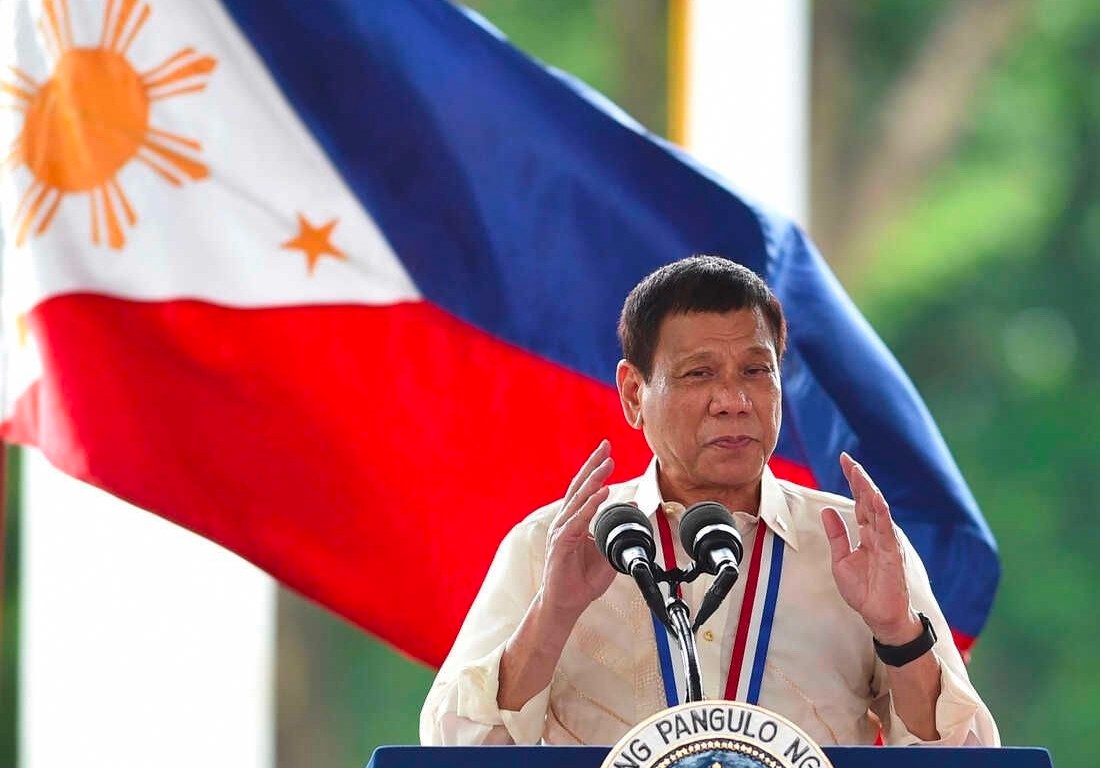
Image: Rodrigo Duterte speaks in Manila (Ted Aljibe/AFP/Getty Images)
This piece is a reproduction from its original issue in Hemispheres vol. 47, no. 1.
 Hemispheres