

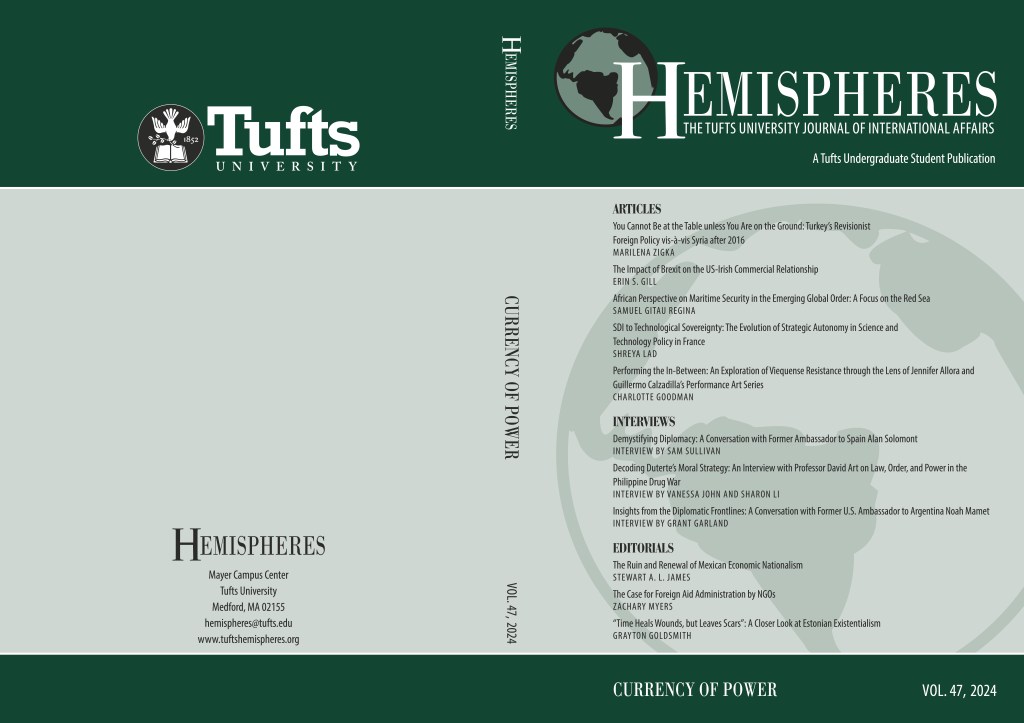
View the latest issue of Hemispheres (vol. 47, no. 2) here or by clicking the image below. Congratulations to this year’s five authors—whose articles were selected among a highly competitive batch of submissions! The following letter from our executive board offers a prolegomenon to the journal and annual theme, “Currency of Power.”
All other objects have a specific content from which they derive their value. Money derives its content from its value; it is value turned into a substance, the value of things without the things themselves. (121)
Since money is not related at all to a specific purpose, it acquires a relation to the totality of purposes. Money is the tool that has the greatest possible number of unpredictable uses and so possesses the maximum value attainable. (212)
The significance of money coincides with that of power; money, like power, is a mere potentiality which stores up a merely subjectively anticipatable future in the form of an objectively existing present. (243)
Georg Simmel, The Philosophy of Money, Third Edition (Berlin: 1907), ed. David Frisby, trans. Tom Bottomore and David Frisby from Kaethe Mengelberg (London: Routledge, 2004).
The idea of power is an apparition to international affairs. Realists hold that states universally seek it, whether for offensive or defensive ends; liberals consider it a prerequisite to the enforcement of good governance; constructivists argue, along Foucauldian lines, that it makes and is made by knowledge or normative systems. Power figures as a fundamental principle in each of these analytical frameworks. In itself, however, this specter is hollow of any substantive meaning apart from pure multiplicity. Power is only observable in the numerous manifest ends which it might realize: territory, institutions, access to markets, military infrastructure, and so on. In this way, as Georg Simmel suggests above, power behaves as a currency. It is one step further than money as an abstraction of things in themselves, from their actual use-value to liquid, future potential.
This 47th volume of Hemispheres brings the currency of power under scrutiny. Power differs from money in that it provides no unit of account; this apparition only makes itself known wherever it is transacted for tangible purposes. Actors in the international system exchange, amass, and disburse power to cover their various exigencies. Just as well, literal and figurative currencies are constantly circulated so that those actors can attain power in its liquid form. We have witnessed the rapid proliferation of new such currencies in recent years, not least in 2023. China and the US vied for a foothold in semiconductor production alongside Taiwan, which has all but monopolized the key industry. Antisatellite tests provoked questions about nuclear weapons deployed or detonated in space as the United States, Russia, and China added to their arsenals of space technology. Israel expended power to launch exhaustive counterterrorism efforts in Gaza, while it struggles to procure approval from journalists and international institutions that widely denounce those measures as ethnic cleansing.
Contributors to this issue of Hemispheres hail from New Jersey to Nairobi, each applying a unique approach to examine the currency of power and detect where this specter operates within global affairs. Some of them consider instances in which power is disbursed toward tangible goals—such as the revisionist turn in Turkish foreign policy toward Syria, or the endeavors of African multilateral institutions to establish coastal maritime security. Other authors demonstrate the converse: how various currencies are amassed and exchanged for power in all its liquidity. One frames Brexit as a counterreaction against globalization in defense of national sovereignty, while consequent shifts in trade flows and foreign investment have shepherded Ireland even closer to the US orbit. Another probes science and technology as currencies by which France competes with US interests. The last ambitiously explores performance art on the island of Vieques, which effectively challenges US hegemony over the Puerto Rican territory.
In their editorials and interviews, our staff within Hemispheres bring attention to additional transactions and reserves of power. Editorialists examine Mexico’s experience of NAFTA/USMCA and its markets for agricultural products; Estonian national identity and European integration; and the influence of humanitarian aid and non-governmental organizations in Ukraine. Interviewers unveil insights into the faculties of diplomatic negotiations by way of conversations with two former Obama-appointed ambassadors. Professor David Art, here at Tufts University, delves into Rodrigo Duterte’s devastating war on drugs in the Philippines and highlights its parallels with Nixon-era policies.
This was a year of great risk for Hemispheres, but one of even greater payoff. For the first time, we launched a second yearly issue in the form of a short, mixed-media magazine written entirely by members. Our staff met every week to ideate, write, and edit seventeen unique pieces that spoke to their diverse interests—from the Nigerien coup d’état to the International Criminal Court to historical memory. After a hectic fall semester, we successfully published the first issue of this 47th volume including explainer articles, maps, photo curations, and interactive quizzes for the broader Tufts community.
The second issue of this volume was made possible by the journal’s passionate and dedicated editorial team. Our Staff Editors readily assumed the challenge of fashioning an entirely new publication while carrying their vigor and enthusiasm forward to produce this spring issue of Hemispheres. We owe further thanks to the authors of the five articles featured here for their collaboration and commitment throughout the intensive editing process. Finally, we extend gratitude toward Alan Solomont, David Art, and Noah Mamet for their thoughtful conversations with our staff.
Yours,
Hannah Cox, Editor-in-Chief
Stewart A. L. James, Managing Editor
Ishika Gupta, Managing Editor
Sam Sullivan, Managing Editor
Jason Y. C. Wu, Senior Editor

