
By Caleb Aklilu and Grace Shoufi
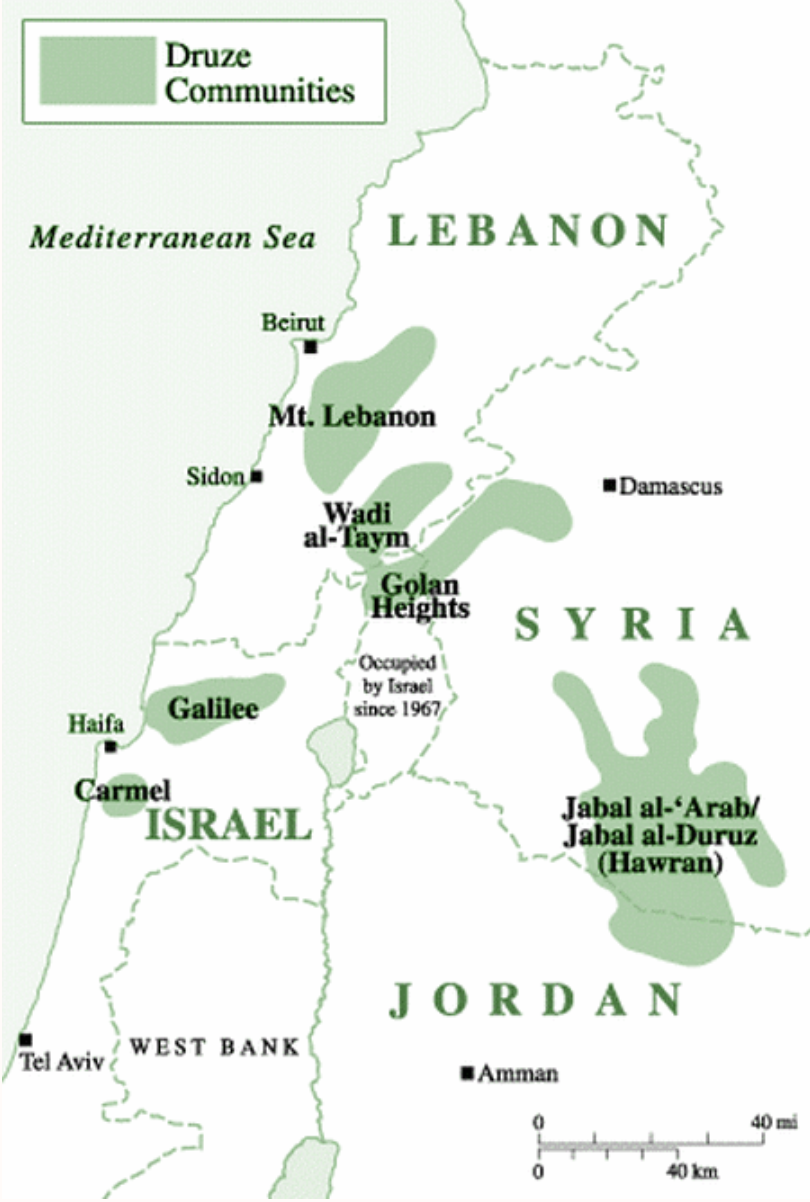
Amidst the ongoing religious and political conflicts in the Middle East are the Druze, a religious minority that has avoided erasure by obscuring their presence through their cultural practices and political maneuvering.
As a neutral minority in a constantly shifting region, the Druze have a long history of enduring oppression. The Druze originated in Cairo around 1017 AD, following their complete separation from Shia Ismailism. The early days of the Druze religion coincided with a period of fierce religious conflict between Islam and Christianity during the Crusades. Because the Druze belief in reincarnation didn’t align with other Abrahamic religions, the Druze in the Levant found themselves positioned between two powerful forces with little compatibility, hindering the development of a natural kinship. In the first instance of a trend that would dominate the group’s policy for centuries, the Druze bandwagoned with the more immediate threat, the neighboring Abbasids, by guarding the Levantine Coast from Crusader incursions. Consequently, the Druze, despite their non-Muslim status, became an integrated part of the Muslim world, taking on a reputation as warriors and guardians of the Middle East. This alignment wouldn’t last, as when the Christian threat subsided, the Muslim rulers began to look inwards, and the non-Sunni minorities in this realm became the predominant threat.
Even after European colonialism and the foundation of Israel disrupted the hegemonic control of Sunni rule, the Druze continue to exist in an unstable environment. The Druze and Israel’s shared opposition to fundamentalist Islamic movements has caused the Israeli Defense Forces to seek Druze integration into Israeli society, rather than expelling them. Israel has also coerced the Druze into accepting citizenship and pressured their social integration under violent and heightened instability in Syria. The Druze, entangled in geopolitical and social tensions, along with policy incentives, had to accept Israeli citizenship and jeopardize their core values of communal independence and religious secrecy.
In Lebanon, a centuries-old rivalry exists between the Christians and the Druze, causing a series of conflicts that left Druze communities massacred. This divide stems largely from the fact that the Druze belief in Pan-Arabism sharply contrasts with the Maronites’ emphasis on the country’s Phoenician roots. Eventually, the Maronite increase in power decreased the Druze position, incentivising the Maronite government to encroach on historically Druze territory.
In Syria, the Druze lived in comfortable coexistence with the Alawite Assad Regime, as they are both rooted in Shia Islam and aligned against the forces of the Sunni Islamist majority. However, following the Arab Spring of 2011, many Druze supported the pro-democracy activists, sacrificing their privileged position as a protected minority by presenting themselves as a threat to the Assad regime’s control. This led to increased friction between the Druze community and government forces in Suwayda, resulting in the dismantlement of pro-democracy groups and the proliferation of Hezbollah’s presence, which caused numerous violent clashes and kidnappings. This showcased how the protected minority status of the Druze was not a partnership but a veiled subjugation.
In the face of continued oppression and the absence of its own nation-state, the Druze community has shown its unique position in resisting oppression. The practice of taqiyya commands the Druze to obscure their faith from outsiders by outwardly adopting the practices of the dominant religious group, allowing this community to survive in hostile states and practice their faith in secret. Additionally, the faith is divided into two groups: the Uqqal and the Juhhal. The Uqqal is the smallest and consists of the group’s religious scholars who have direct knowledge of the faith’s scripture and secrets. The Juhhal is the majority of the Druze community and is not granted access to scripture or Uqqal assemblies. This separation enables their preservation by concentrating the majority of the faith’s religious obligations into a small elite minority, relaxing the commitments on the Juhhal as to allow them to practice Taqiyya. The resulting secretive nature of the Druze religion has allowed it to survive as a stateless religious minority in a region dominated by hostile nations.
Today, the Druze continue to adapt to the conflicts of the Middle East by integrating into neighboring geopolitical and domestic power structures. Despite making up only 5 percent of Lebanon’s population, the Druze are well-represented in Lebanese society and government, guaranteed both cabinet posts and parliamentary seats. This power has been achieved through the influence of the Jumblatt and Arslan Druze families, who have leveraged their political power to ensure Druze presence in Lebanon. This governmental power allows Druze culture to be recognized during times of crisis, as Druze government representatives likely pass legislation that favors them.
Amidst the current instability in post-Assad Syria, the Druze continue to ensure their survival and sovereignty by forming militias. The Druze National Guard, for example, was established to protect the Druze community and the Suwayda region against external threats. These militias have also called on Israeli asymmetric support to prevent potential genocide and displacement of the Druze after the fall of Assad by the Syrian Transitional Government.
To continue to reject assimilation and ensure the survival of their culture, the Druze have actively participated in the Israel Defense Forces (IDF) since the 1950s. This participation began after Druze leaders themselves sought conscription to secure equal status, social mobility, and protection within Israeli society. The Druze Initiative Committee, a Druze organization opposing forced conscription policies, has also provided a platform for resistance through demonstrations against land confiscations and citizenship issues.
For over 1,000 years, despite not having their own nation-state, the Druze have maintained their culture through traditions that emphasize confidentiality and integration into local power structures. From Lebanon to Syria to Israel, their resilience reveals not only a history of survival but also of continued assertion of agency in hostile environments. While nation-states rise and fall around them, the Druze remain anchored in their centuries-old strategy of preservation through adaptation: a people without borders, yet deeply rooted in their heritage.

