
By Evelyn Bertolini
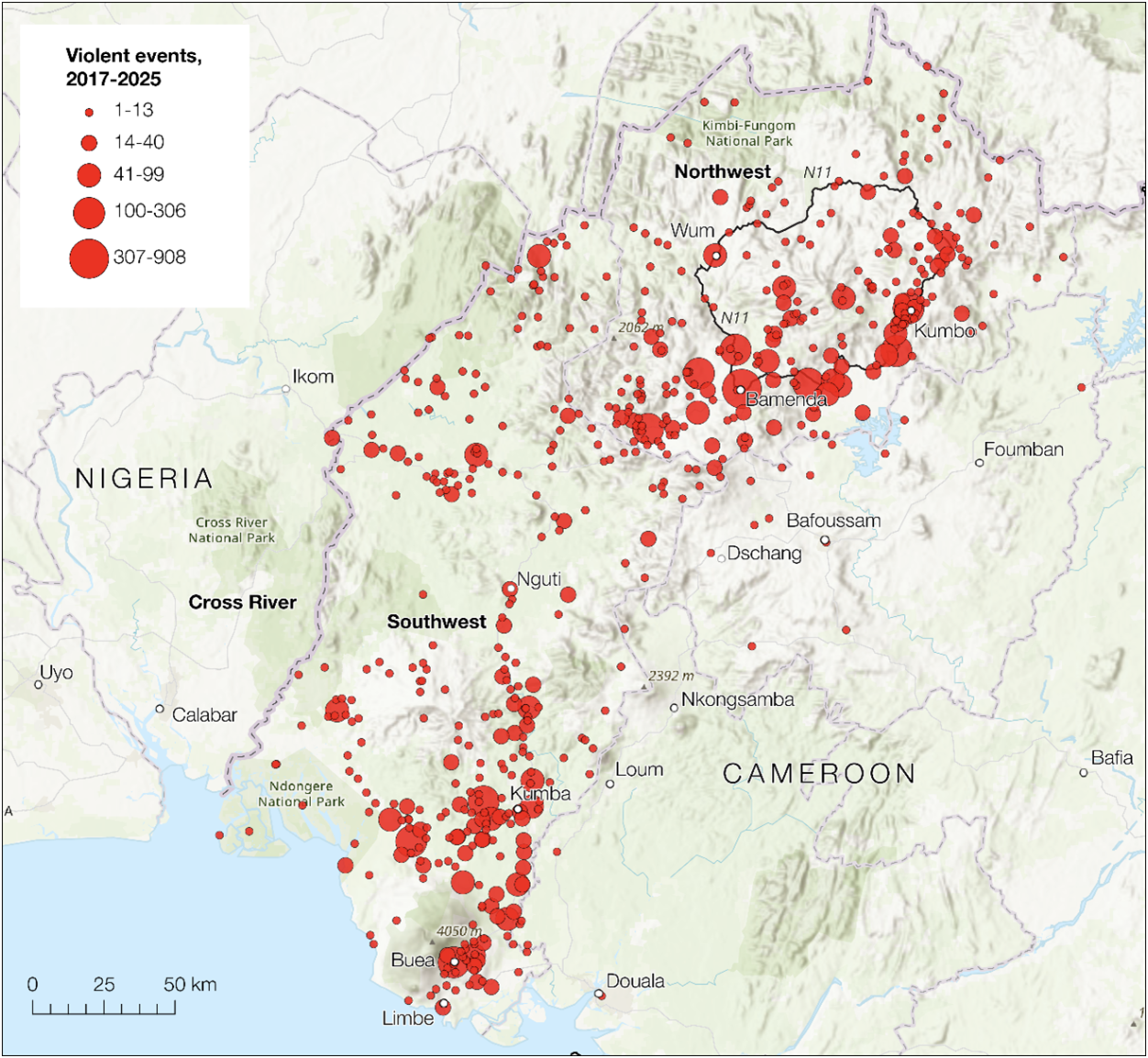
In the midst of today’s increasingly turbulent international political climate, the UN and other global powers have failed to recognize human rights violations they consider less imperative to immediate international order. Cameroon’s Anglophone crisis, an armed conflict between English-speaking separatists and the Cameroonian government, is a product of colonialism that has been worsened by international neglect. The conflict, based in deep interlinguistic dissent, has ravaged the country, with an estimated death toll of 6,500 and hundreds of thousands more displaced from their homes.
The government’s response to a 2016 Anglophone protest, rife with extrajudicial killings, sexual violence, and gender-based violence, did little to quell the Anglophone minority’s concerns of marginalization at the hands of the Francophone-dominated government. Since then, separatist groups have contributed to violence in the country’s Northwest and Southwest regions and have called for independence of a separate Anglophone state of Ambazonia for the 14% of the Cameroonian population that speaks English. Tensions have worsened and will continue to do so in the wake of the 2025 presidential election. 48 people were killed by government forces as they protested the re-election of Paul Biya, who has held a dictator-like grasp over the country since 1982 and has just entered his eighth term.
Demands for a separate state may appear justifiable given the country’s divided history; after WWI, Cameroon was divided between Britain and France, which resulted in a linguistic and cultural split. The demands for independence, however, don’t take into account the state’s current political system. In 2022, data showed that Cameroonians severely lacked political and civil liberties while facing a corrupt and autocratic government. Marginalization cannot be mended with the creation of a separate state; rather, current unrest must be addressed at its root in governmental injustice. Without international intervention and significant governmental reform, the government-caused conflict will persist, whether as separate states or a nation divided against itself.
Potential solutions are complex but begin with pressures from abroad, which have had a record of success in African countries facing unjust governments. South Africa’s Anti-Apartheid movement saw violence catalyzed by extremist group Inkatha, which aimed to create a state of the Zulu people, a major ethnic group. What proved effective for the South African case was international pressure. For highly unstable nations such as Cameroon, multilateral organizations such as the UN and EU hold a massive amount of sway over the domestic order of the country and should use it to condemn the ongoing human rights violations. In South Africa, this meant installing mandatory embargoes and issuing official condemnations of the discriminatory governmental system. A similar intervention in Cameroon is necessary to end the conflict.
When violence reaches a point where innocent citizens are being harmed, displaced, and killed, and the education of the youth is at stake, it is the responsibility of international powers to uphold moral standards. The well-being of global order is fundamentally linked with the well-being of the order’s people; international stability cannot stand where injustice persists.

