
By Hailey Renick
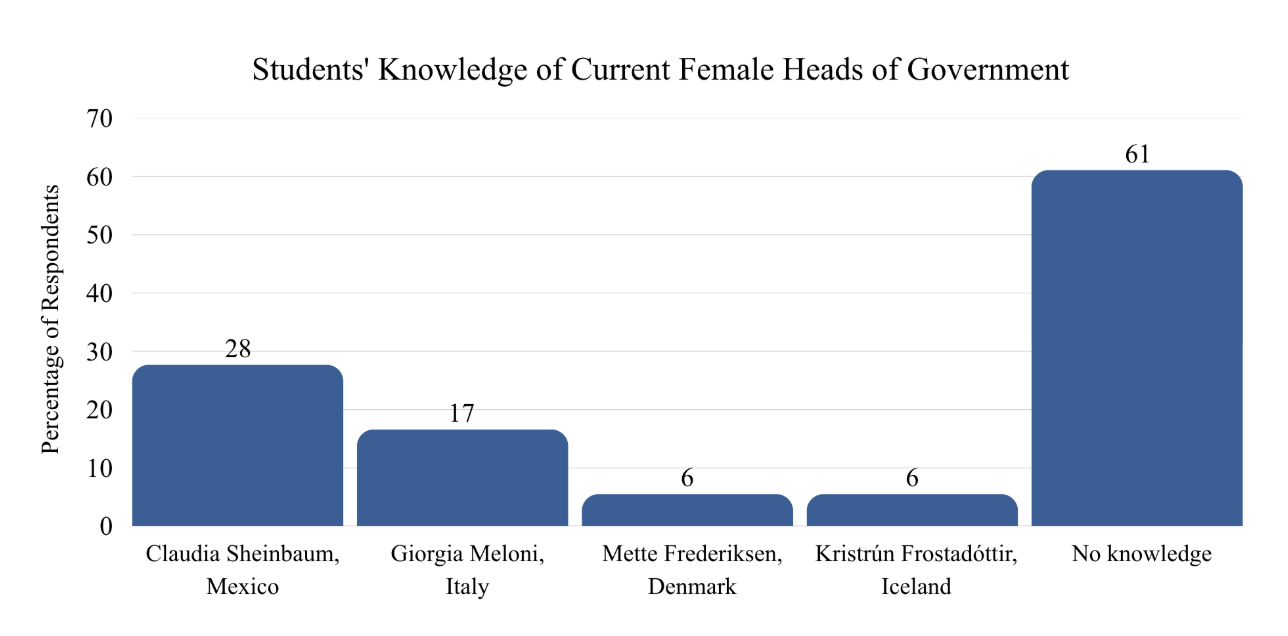
When asked to name a woman currently serving as a head of state, the majority of students interviewed could not do so, reflecting how deeply gender disparities persist in global politics. Over the past year, the number of women in government positions has decreased, further inhibiting global progress toward gender equality.1 What remains is a political landscape dominated by “strongman” leaders who embody the neorealist tendency of hard power to secure influence through aggression and force, showing that political institutions still reward masculine traits. Traditionally, hard power is depicted as masculine, while its reciprocal, soft power, which consists of diplomacy and collaboration, is associated with feminine qualities. The assertive use of hard power establishes an illusion that quick-acting leaders are more capable, while reflective, cooperative leaders are less decisive and often dismissed as weak.2 The gendered framing tied to these ideas creates a specific perception of an “ideal leader.”3 As this ingrained power imbalance persists in political systems without apparent progress toward change, the following Tufts students shared their perspectives on ensuring more representative leadership:
Gavin Evans, Freshman, studying History and Economics:
Gavin pointed out that in many regions, particularly parts of the Middle East and Africa, cultural and religious traditions continue to shape resistance to female leadership. “You can’t necessarily change people’s moral and cultural values,” he noted, though he acknowledged signs of gradual progress. For him, globalization and technology offer a path forward. As younger generations connect across borders, exposure to global ideas of gender equality may soften these cultural barriers.
Savvy Thompson, Senior, studying International Relations at The Fletcher School:
Savvy warned against performative representation. Elevating women merely to check a box, she argued, risks undermining the credibility of qualified candidates. Instead, she emphasized the need for structural support, like campaign infrastructure, funding, and mentorship, to allow women to succeed on equal footing. “Women shouldn’t be evaluated as women, but as people,” she said, adding that true equality means assessing candidates by merit, as representation alone is not progress unless it is grounded in capability and genuine inclusion.
Isabela Silvares Lima, Junior, studying International Relations and History:
Bela discussed that a solution should be founded on a societal shift in the perception of leaders rather than the simple act of acquiring more representation. In communities where women are encouraged toward traditional gender roles, fewer women feel empowered to pursue political power. This cultural conditioning sustains the expectation that leadership must look masculine, and she states, “The roles held within international politics remain guarded by societal gender roles rooted in patriarchy.” She pointed to nations like Finland, Australia, and Sweden as examples of how cultural acceptance normalizes female leadership. In contrast, countries such as Iran and Saudi Arabia still reinforce patriarchal norms that confine women to domestic roles. For Bela, dismantling patriarchal politics requires a societal reimagining of who can lead.

