
By Lucy O’Brien
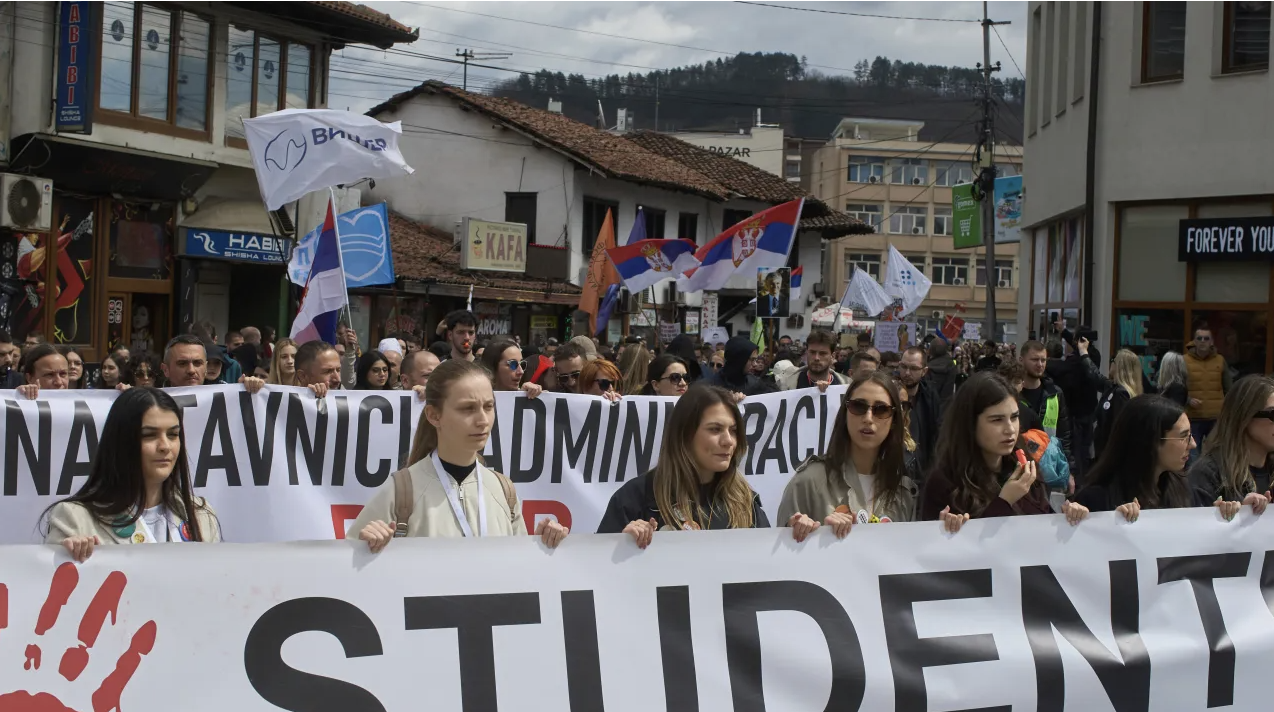
On November 1, 2024, a recently reconstructed concrete canopy collapsed at a railway station in Novi Sad, Serbia, killing 16 people. In the following weeks, the disaster became a catalyst for national outrage, as student protesters claimed the faulty construction exposed a broader trend of negligence and corruption in the Serbian government.
Gatherings began as peaceful vigils held by local university students and faculty to commemorate the lives lost in the disaster. However, following the government’s refusal to take accountability for the tragedy, students moved to the streets, organizing traffic blockades and demanding transparency, effectively shuttering their school in the process. By the end of December, thousands of university students followed, earning support from agriculture workers and the Bar Association of Serbia. The movement quickly gained national attention, as many Serbians saw the government’s dismissive response as a clear demonstration of an incompetent government fractured by corruption.
Protesters largely blame President Aleksandar Vučić and his majority Serbian Progressive Party (SNS) for this corruption. Prior to presidential wins in 2017 and 2022, President Vučić served as Prime Minister from 2014 to 2017. He has spent his political career cultivating deference in the legislative and judiciary branches and consolidating power within the presidency, a position originally intended to be primarily ceremonial. Although his populist politics express a desire to align with Western values, Vučić has maintained close relations with Russia and China (the renovation was part of a larger initiative with Chinese construction firms). Under Vučić, the very institutions designed to prevent disasters—such as the one in Novi Sad—from regulatory agencies to the judiciary have been co-opted to shield politicians and the ruling elite, rather than serve and protect public interests.
Protests have only grown since December. In March, Serbia saw the largest recorded protest in its history. According to an independent monitor, 325,000 people gathered in Belgrade, although the Serbian government reported 107,000. Vučić, hoping to outlast the wave of dissent, has refrained from exercising the full force of his power against protesters. Since June, SNS-supported police and mob interventions had doubled, with thousands of protesters beaten, chased, and arrested. Those who violently attacked protesters have been repeatedly forgiven and defended on national television by Vučić himself. Not only has the degraded justice system failed to punish high-level corruption, but it has also been weaponized by the elite to threaten and legally harass their critics. Additionally, the government-controlled media has been utilized to paint the protesters as foreign-backed terrorists bent on destroying Serbia, as well as unlawfully publishing personal details of participants.
The student protestors have four formal demands: publication of the entire documentation on the reconstruction of the railway station; dismissal of the charges against arrested and detained students, activists, and citizens at protests regarding the tragedy in Novi Sad; criminal charges against all attackers of students, professors, and citizens; and a 20 percent increase in funding for state universities. Until these demands are met, the protests will likely continue in full force.


One thought on “A Reckoning for Serbia: Massive Anti-Corruption Protests Persist”
Comments are closed.