
By Keira Klein and Mia Newman
Introduction:
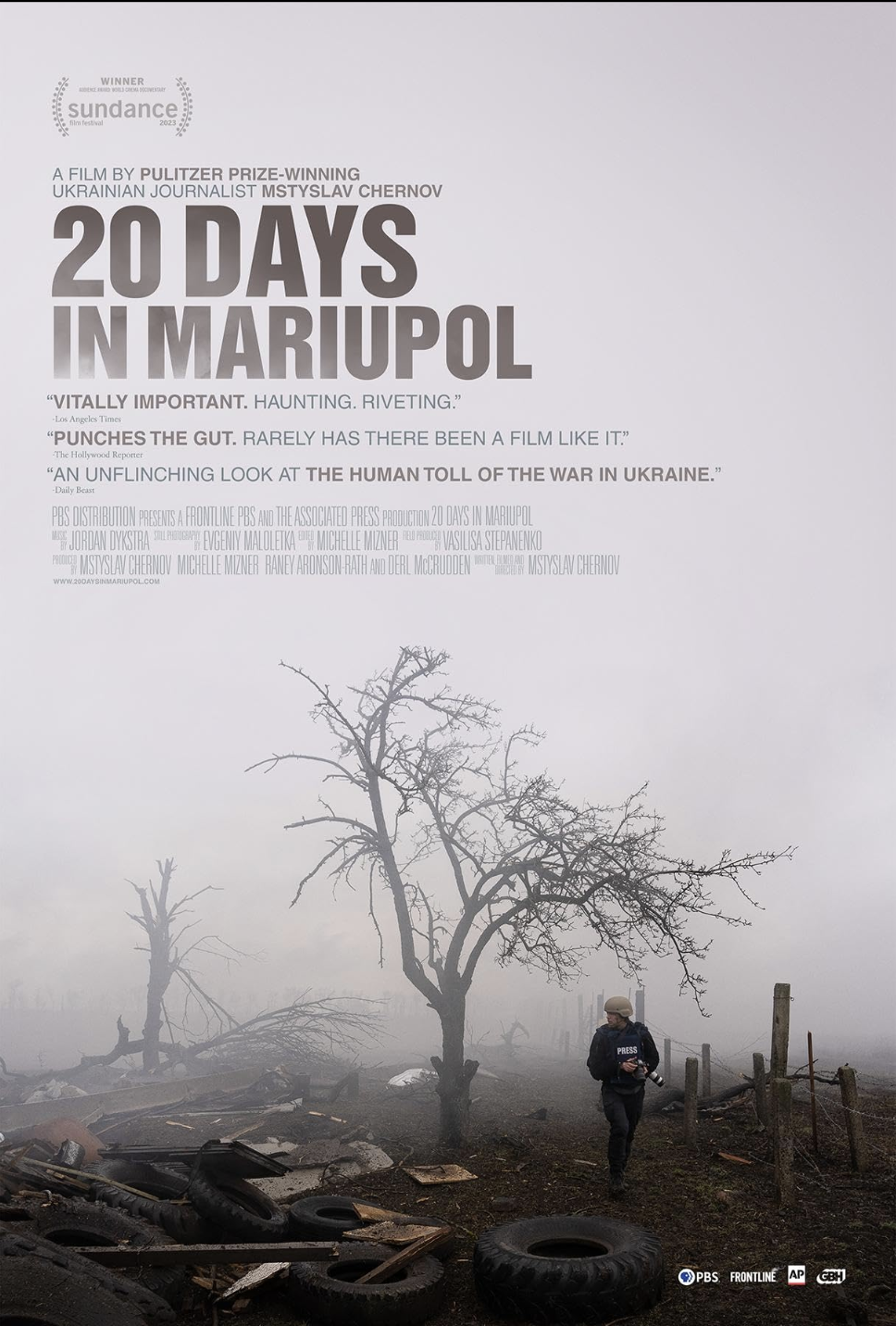
20 Days in Mariupol is an Oscar award-winning documentary that follows Associated Press reporter Mstyslav Chernov during the first 20 days of the Russia-Ukraine war in the Ukrainian city of Mariupol. As a journalist, Chernov records the series of events as Russian forces attacked civilians and blocked humanitarian aid from entering the city. His captured footage is almost exclusively the only footage released from Mariupol, as the Russians cut off all radio and internet access. The publication of the footage released in 20 Days in Mariupol is crucial in documenting the potential war crimes committed by the Russian army — footage that has continually been defamed as fake by Russian authorities.
Summary:
From one of the opening lines, “Wars don’t start with explosions; they start with silence,” Chernov establishes the documentary’s unsettling tone. The first day of attacks are marked with terror and confusion. Russia targeted the city of Mariupol because it would provide access to the coast and serve as a key connection to the Russian-controlled territories of Crimea and Donbas. Despite Russia’s insistence that civilians would not be targeted, Chernov’s footage and reporting quickly disproves this notion. Moments after Putin’s official declaration of war, the first strikes in Mariupol begin. The handheld camera, shaky and urgent, immediately immerses the viewer in chaos. Chernov hides in a basement with several Ukrainian families, capturing the reactions of a panicked woman worried about her son and a tearful child who wakes up to discover that war has begun.
On Days 3–11 of the crisis, Chernov hides in Emergency Hospital II, where he captures small, impactful moments such as zooming in on a dying woman’s hand shaking tremendously before suddenly stilling, and filming a man hugging his 16-year-old son, Ilya, who died playing soccer. Chernov additionally displays bloody children’s shoes on the floor and a woman kissing her 18-month-old child, Kyryl, goodbye before collapsing into tears. The choice to focus on such intimate, human details instead of large-scale destruction gives the film its devastating power. Chernov sends this footage to his editors saying, “This is painful to watch. But it must be painful to watch.”
On Days 14–16, the hospital overflows, morgues fill, and bodies are buried in mass graves. Chernov wonders aloud whether some of the corpses being tossed into pits are people he filmed just days before. When the maternity ward is bombed, his camera captures shattered cribs, splintered incubators, and the desperate cries of an injured pregnant woman, Iryna. In one of the film’s most heartbreaking sequences, Chernov learns that both Iryna and her baby perished during doctors’ tireless efforts to save them. With the help of a local doctor named Vladimir, Chernov transmits this footage to his editors. Soon, the images of the destroyed maternity hospital appear on major news sources. The publication of this footage sparked international outrage, placing a spotlight on Russia’s human rights violations — despite Russian insistence that the footage was staged.
On Day 17, Chernov spies Russian tanks, embellished with their signature “Z,” approaching the hospital from a distance. While escaping, Chernov captures the panic of the moment, his unsteady camera rattling with every stride he takes. Even while fleeing, Chernov remains committed to his role as witness.
On Day 20, Vladimir brings Chernov to the city’s Red Cross convoy, as he learns that this will be one of the last chances for him to escape. While they drive, Chernov captures the gray skies and destroyed buildings of Mariupol, narrating, “The city is slowly dying, like a human being.” The film ends with a haunting shot of a gray, destroyed Mariupol and a Russian flag rising over its ruins. The somber background music fades into silence, marking the official end of Ukrainian control in Mariupol.
Our Thoughts:
20 Days in Mariupol is more than a documentary; it is an act of witnessing. Through his commitment to documenting the siege of Mariupol, Chernov ensures that viewers of his film become witnesses to this tragedy and to the suffering of its people. It is one thing to read an article or to examine statistics about a conflict, but watching direct footage of those affected evokes a deep sense of empathy — bringing audiences closer to the human reality of war rather than only the geopolitical dimensions. By capturing the honest and raw truth of Mariupol and highlighting individual stories, Chernov guarantees that this piece of history will never be forgotten.
While 20 Days in Mariupol is especially useful to those studying the Russia-Ukraine conflict and its effect on civilians, everyone can benefit from watching this documentary. This film allows us to virtually step into the shoes of Ukrainians, making this complex conflict tangible, and compelling us to imagine the loss of their city, despite never having met these people in reality. The power of film ensures the story of Mariupol is shared and heard, keeping the catastrophic impact of the Russia-Ukraine war relevant along with immortalizing it. We strongly encourage everyone to watch this documentary and share the responsibility of bearing witness to Mariupol’s history.
To watch the film, please visit PBS

